
After an extremely busy end of season, I thought it would be a nice idea to do a little diction post on this platform about one of my favorite subjects: Liaison

After an extremely busy end of season, I thought it would be a nice idea to do a little diction post on this platform about one of my favorite subjects: Liaison

After years of coaching French repertoire, I have come across some difficult words which people struggle to pronounce, unless you know how to say them. There is no way to figure them out unless you are a native speaker. Pronouncing these words cannot be solved with diction rules or IPA (International Phonetic Alphabet). Let’s look at three of these particular words and some contexts where you can find them.

How do you achieve this if you are not singing in Italian? More specifically, how do you accomplish this while singing in French? Without diving into the numerous French liaison rules, here is a quick explanation of three different ways you can link words in your French singing.

A common point of confusion in French Lyric Diction is knowing when to pronounce the -ill(es), -il(s) as a Yod [j], and when do we pronounce this double “ll” combo as just one “l” [l]. There is a method to this madness, and it is not so complicated.
If the term”Yod” or “j-glide” is stumping you, you can check out one of my past blog posts on the subject of semi-consonants to catch up!
i or ï is pronounced as a [j] when preceded by a single consonant when it is in front of an a, e, o, or eu. Beware: not when it is in the middle of a word -ie- in some verbs and their derivatives or as the last sound of the word -ie.
For example:
Avant de quitter ces lieux, sol natal de mes aïeux (Before leaving this place, native soil of my ancestors), Valentin’s aria from Faust by Gounod
[aˈvɑ̃ də kiˈte sɛ ljø sɔl naˈtal də mɛz‿aˈjø]
In the example above, in the words “lieux” and “aïeux”, the i and ï are pronounced as a glide. Both of these vowels are in front of eu.
But we do not make a glide in the future tense conjugation of verbs like “oublier” (to forget) [ubliˈe]
J’oublierai (I shall forget) also does not have a glide; in fact, the e vanishes in pronunciation. I often hear [ʒubliəˈre], but the correct way to pronounce this word and other words like it is: [ʒubliˈre]
When -ie- is at the end of a word, it is simply [i] unless the composer gave a note value to the schwa, in which case it will be [iə], and we should not hear a glide between these vowels.
Examples:
Un deuil amer (bitter mourning) [œ̃dœj‿aˈmɛr]
but in the word fille, we add an [i] in front of the glide; otherwise, there would be no vowel in the word: jeune fille (young girl) [ʒœnə fijə]
As anyone who has ever studied the French language or French diction knows, there are many rules to follow, but there are just as many exceptions to the rules, if not more.
When il(s) is at the end of a word and follows a consonant, the i is [i], and the l is sometimes silent and sometimes sounded.
The following is pronounced without an l or a glide.
The following is pronounced without a glide but with an l
You could memorize this list, consult a French dictionary for the IPA translation on these more special words, or refer back to this post.
The exception also applies to the ll in the following words and their derivatives:
If you don’t want to forget, memorize this phrase: Milles villes tranquilles: “A thousand tranquil cities” then you will remember that every word belonging to the family of these three words in French are pronounced as [l] rather than a [j].
These tips should help you navigate the world of “glide or not to glide” when it comes to the YOd and how to avoid making mistakes while singing, or speaking!
We don’t always have a dictionary in our pockets, and let’s face the fact that we are in a digital age, no matter how much we love actual books. My favorite French dictionary online is the Larousse: https://www.larousse.fr/ This dictionary has been my go-to since as long as I can remember, it has it all, and the online version is quite good to work with.

Maybe you have heard this term before, or perhaps it is new to you. When I coach people for the first time, it always seems like they are familiar with Vocalic Harmonization, but they are not sure how to use it. It is a term used in linguistics when applying the rhyming of closely related vowels in the same or words that follow each other. It is also known as “vowel harmony”. The practice of vocalic harmonization is most often used in the French vocal repertoire for linguistic refinement and ease of vocal production. Most frequently in French singing, we harmonize [ɛ] with [e] and [œ] with [ø]
For example: “aimer” [ɛˈme] becomes [eˈme] or Heureux [œˈrø] becomes [øˈrø]
As you can see in the examples above, the unstressed, open vowel-sound closes to rhyme with the following stressed, closed vowel, not the opposite. Remember, it is the final syllable that is stressed in French, except when that syllable is a schwa-sound [ə] because a schwa can never be stressed. In this case it is the syllable before the schwa that gets the stress.
the possibility of vocalic harmonization also exists in closing the [ɛ] in short words such as les, tes, ces, etc. (these are articles or possessive adjectives). When a closed vowel immediately follows these, they can be closed to an [e].
For example: les étés [lɛz‿eˈte] would become [lez‿eˈte]
The article “les” is harmonized to the closed [e] in “étés”
These harmonized syllables must never be accented or overly closed, and at times they only are slightly closed on the way to their closed neighboring vowel-sound, and over-closing the harmonized vowel can result in obscuring the text. The idea is that it should feel natural and sound authentic since vocalic harmonization occurs in everyday speech but not deliberately. Many native French speakers do not even realize that they are doing this.
Some French words are almost always harmonized. For example, the following words would have all open vowels in the first syllable if we followed the diction rules, but they are sung and spoken with vocalic harmonization:
aimer (to love) [ɛˈme] becomes [eˈme]
baiser (to kiss) [bɛˈze] becomes [beˈze]
heureux (or heureuse) (happy) [œˈrø] becomes [øˈrø]
Vowel harmonization should not be systematic. It is a completely optional choice left to the singer. In cases where it can help the legato line, it is recommended to harmonize the vowels as sometimes it is easier to get through a phrase with fewer vowel changes.
For example:
Let’s take a look at “Lydia” by Fauré. In this text we find this line: “Laisse tes baisers de colombe”
The “tes baisers” can be sung as all closed [e] but the “laisse”” remains an open [ɛ] because the vowel following it is not a closed vowel.
[lɛsə tɛ bɛˈze] becomes [lɛsə te bɛeze]
Speak it out loud both ways and see the difference for yourself.
I would also go further and say if you have an article or possessive adjective (les, des, mes, tes ses) and the following word begins with a closed [o] or any vowel that has a closed feeling such as [i], [ø] [õ] [y] or [o], you can apply vocalic harmonization.
Again in in “Lydia by Fauré:
“Lydia, sur tes roses joues” you can harmonize the “tes” which would typically be [tɛ] to a closed [te] to match the closed [o] sounds of [rozə]. But, the “mes” in “mes amours” in the same song stays [ɛ] because a closed vowel-sound does not follow it.
Here is the text of Fauré’s Lydia where I will highlight the vocalic harmonizations:
Lydia, sur tes roses joues
Et sur ton col frais et si blanc
Roule étincelant
L’or fluide que tu dénoues;
Le jour qui lui est le meilleur
Oublions l’éternelle tombe
Laisse tes baisers de colombe
Chanter sur ta lèvre en fleur.
Un lys caché répand sans cesse
Une odeur divine en ton sein;
Les délices comme un essaim
Sortent de toi, jeune déesse
Je t’aime et meurs, ô mes amours,
Mon âme en baisers m’est ravie
O Lydia, rends-moi la vie,
Que je puisse mourir toujours!
In this recording of Véronique Gens and Roger Vignoles, you can hear the use of vocalic harmonization as highlightede above.
Try not to over-use vocalic harmonization. Remember, it should not obscure the text, and it should be helpful to the singing. If you are not sure if something should be harmonized or not, ask your French diction coach, or listen to several recordings to see what the consensus is. Just know that some coaches don’t apply vowel harmony and there are differing opinions on the matter. Since it happens in everyday speech, and I have seen it help so many singers in their legato and ease of singing, I generally encourage vocalic harmonization when appropriate.

The French r may be one of the most discussed sounds in the French language. It is also one of the most challenging sounds for a non-native French speaker to produce authentically. There are many ways to go about singing the French r.
Let’s look at the three most commonly used r-sounds in singing French repertoire:

So now that we have listed the three most commonly used r-sounds in French singing, which ones should be used?
Although the “rolled r“ has quite frequently been used in the singing of classical French repertoire, and it feels good to do it (sometimes it may feel expressive to roll an r), my advice is to avoid using it. Whenever I hear someone over-rolling an r in French music be it mélodie or opera, it ends up sounding very close to Italian. Also, any double consonant (except for a few words) should not be observed, so even if you see a double r, you do not need to roll it.
In the following clip, Chanson d’Orkenise from Banalités by Poulenc, Pierre Bernac, who was and still is an authority on singing in French, makes use of the “rolled r” (or one could argue that it is a repeated flipped r). It is still beautiful, but it has a flavor of the past mostly due to the r which is very rolled. This is a good example of how they were singing in French in this period.
The “flipped r” is my personal favorite to use in classical French music. This r is a lot like its rolled counterpart. If you use it while speaking, it feels very strange and foreign but it sounds very comfortable while singing. It does not misplace the voice and it does not disturb the legato line. It is the r most commonly used in French opera and mélodie. In this recording , you hear an excellent use of the “flipped r” used by Véronique Gens.
There are a lot of discussions about the use of the “uvular r“ in classical singing. While speaking French, we all use this r but should we use it when we are singing classical music? In France, Belgium and I believe in the French-speaking regions of Canada, the “uvular r” is recommended for singing in French. From a singing perspective, the argument arises that this places the sound too far back in the throat and that a “flipped r” keeps the sound more forward. In my opinion, the use of the “uvular r” gives a “pop music” feeling to the music. The discussions surrounding which r we should be using are ongoing. My advice is if you are not a native French speaker, do not use the “uvular r” because the chances are you will not make a convincingly authentic “uvular r” sound while singing.
I once had a student who was not French, bring in a French aria he had studied all week. Before singing it, he said: “I don’t know why, but every time I sing this aria, I have a sore throat”. Alarmed, I wanted to hear it to see if he was doing anything wrong. It should be noted that this aria was very r heavy. Well, as soon as he started singing, I heard it immediately, he was using his version of the “uvular r”, but it was much too hard and aggressive, we switched to the “flipped r” and everything was solved. We had a good laugh about it afterward!
In this third recording of Chanson d’Orkenise by Poulenc, Patricia Petitbon opts for the “uvular r“. She does it with subtelty and she is gentle with the attack but you can hear that it is in the back of the throat.
My strong advice (and many of my voice teacher colleagues agree) is to use the “flipped r”. Whatever you decide to use, make sure it does not compromise the quality of your singing. Practice now and then with a “uvular r” in case you go off and work with someone who will have this as a preference, and it is requested of you to use it. Work it out with your French coach and your voice teacher to help you to do it healthily and authentically.

One of the most frequently asked questions I get during a coaching session on French repertoire is: “What do I do with the “h”? My regular students can recite this rule at any time in any place. It is one of the rules that I drill into them!
The French language went through changes phonologically between it’s origin, Latin, into what we know now as Early Old French. One of the major changes was the loss of the “h” consonant. It briefly made a comeback when germanic words were introduced into the French language, but the aspirate h ceased to be pronounced once more in either the 16th or the 17th century and this hasn’t changed since then.
Since the phonological behavior of aspirate h words cannot be predicted through spelling, usage requires a considerable amount of memorization or a bit of research. In the past, the misuse of the “h” was often used to size up someone’s education and social status. In modern usage, the knowledge of how we treat the “h” in “liaison” is more indicative of formal French, but it is not so present in less guarded speech. In general, the use of “liaison” is also losing ground in the less formal or slang use in the French language all around.

It is important to note that the “h” is never sounded in the French language, not in speech, and not in singing! So why do we have to know if it is aspirate or nonaspirate? In French, the letter “h” permits or forbids “liaison” furthermore its presence can mean a slight soft reattacking of the vowel-sound.
Example:
Qui dans les halliers humides te cueille! (Who in the damp thickets gather you!)
IPA: [ki dɑ̃ lɛ| aˈliez ͜ yˈmide tə kœjə]
Note that before the word “halliers” there is a slight stop and no liaison because the “h” is an aspirate h. Before the word “humides” there is a liaison because this “h” is nonaspirate.
As stated above, in normal everyday speech, a native French speaker would probably opt out of using a liaison, and most words which are nonaspirate, as they already instinctively recognize them and link them. While singing, however, it is very important to use the appropriate diction. When in doubt, just look it up in the dictionary for the asterisk (*), and remember the rule: It is forbidden to make a liaison on a word beginning with an aspirate “h”!

What is a Semi-Consonant?
When you speak (or in our case sing) in French, there are 36 sounds to master:
In today’s post, we will focus on the semi-consonant-sound.
The Semi-Consonants
Semi-consonant [ɥ]
Model word: nuit [nɥi] (night)
The corresponding sound for the [ɥ] is the phonetic [y] as in the word “lyne” in French
The Yod [j]
Model word: Dieu [djø] (God)
The corresponding sound for the [j] is the phonetic [i] as in the word “midi”. We often refer to this one specifically as a Yod. Think of saying the word “you” in English, that first glide is our [j].
Semi-consonant [w]
Model word soir [swar] (evening)
The corresponding sound for the [w] is the phonetic [u] as in the word “tout”. Think of saying the word “we” in English, the first glide is our [w].
1. They are always before the vowel-sound of the syllable.
In French syllabification, each syllable can only have one vowel-sound per syllable, some vowel combinations make a vowel sound
Example:
2. They are introductory closures that open into or glide into the more open vowel sound, which in turn occupies the duration of the note-value.
You should never sing or elongate the semi-consonant, the glide should be made swiftly as you always aim for the vowel following the glide. If we look at the IPA for “nuit” [nɥi] the most important vowel to sing is the [i] which comes after the glide.
3. They never, in themselves, constitute a syllable. When they become vowel-sounds (and/or when they are assigned a note) they lose their qualities as semi-consonants, each being transformed into a particular vowel-sound.
Because we never elongate the semi-consonant, it cannot be a vowel-sound UNLESS they are assigned a note in the text:

In the example above, the first “curieux” has two notes, and clearly, you would have to use the glide to get to the [ø]. In the second example, the [j] loses its glide quality and becomes a vowel thanks to the composer who gave it a note value.
In the spoken French language, when a word ends in a vowel + mute “e” (a.k.a schwa), we do not pronounce the schwa.
For example “joie” (joy) is spoken without the last “e” [ʒwa], but many French composers gave a note value to the schwa, so that when you sing the word “joie” you would have to sing this otherwise mute “e” [ʒwaə].
Setting the mute “e” as accurately and elegantly as possible was always a goal for the French composers:
So when you sing the aria “Que fais-tu, blanche tourterelle” from Roméo et Juliette by Gounod, you will see the following:

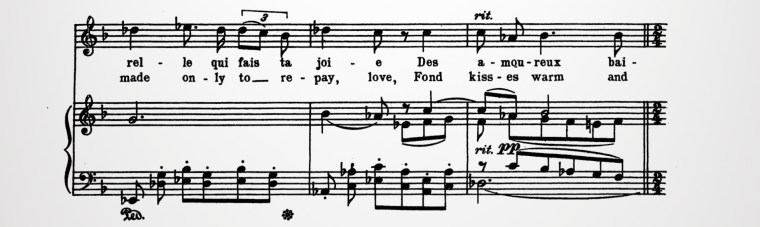
Looking at these two excerpts from the aria, you notice a note value given to the schwas in the words “proie” and “joie”. The danger here is the temptation to insert a [j] between teh [wa] and the [ə].
The correct way to sing this is as follows:
Laisse-là ces oiseaux de proie, Tourterelle qui fais ta joie
[lɛsəˈla sɛz‿waˈzo də ˈproiə turtəˈrɛlə ki fɛ ta ˈʒwaə]
And not
[lɛsəˈla sɛz‿waˈzo də ˈprwajə turtəˈrɛlə ki fɛ ta ˈʒwajə]
Believe it or not, I hear the addition of a Yod quite often, and sometimes from established singers. It is probably not because they mean to do it; gliding cleanly between these vowels takes a lot of practice. Not to mention that if you glide between the vowel and the schwa, you will create a stress on the mute “e” which is not allowed…You have all seen the meme:

Adding a glide between these vowels, creates confusion because it does not sound like the right word, and it is a dead give-away that you are not French. The transition between these vowels must be seemless. Happy gliding!


“Make haste slowly”
This is what my mentor and teacher, the late Dixie Ross Neill used to repeat to me when I was studying with her, but Caesar Augustus is said to have first adopted the motto: Festina Lente. Make haste, slowly. It took me a while to understand what it meant. I think that when I was a student, I was impatient and maybe a little result-driven. Imagine, back in those days, no social media or profiling trends were pushing me to show my results to the world. Fast forward to 2020, we are the age of social media, instant fame, and being discovered on big platform talent hunts. How does a young aspiring singer get to their desired result while fighting the temptation to skip steps?
I work with singers, and a big part of my work is training young singers who are more than aware of their online content. Knowing how to brand yourself, is an important skill, but the question is, are we skipping important voice building steps in the rush to get “there” faster? Some go into the process, they lay down the base for a great technique, let the voice develop, work on their languages, musicianship skills, bodywork, all of which make someone into a complete artist. Then, there are some who lack patience and are always running after results. They put in the work, but they always try to skip steps because they want to get there faster. With the latter, you can feel an actual sense of panic, which some may confuse with ambition. Skipping steps can make them feel like they are getting there faster, but the truth is, they will inevitably have to turn back and redo the steps they have skipped.
What does it mean to make haste slowly? Let me use the following metaphor: A pianist, while learning a difficult musical passage which is at a high level of technical difficulty is tempted to just play it at tempo, just do it, get it on the first try. There may be a slight chance that they get it right on the first try, but what about every time after that? What will happen to the consistency of their playing? How will they know if it was just a fluke (which it absolutely was)? They now go back, dissect the passage, play it slowly, practice with different rhythms, build up tempo, work on the fingering, and put in the necessary amount of time to learn it from start to finish. Instead of doing it instantaneously and risking that it is just a fluke, the goal now becomes not only to do it right but most importantly, to learn it so that you never do it wrong.
Building your career as a singer is a lot like that pianist working on the difficult passage. Just because you are talented, have a beautiful voice, and sometimes you get it right on the first try, does not mean that you are ready to hit the ground running. Like the pianist working on the passage above, you will want to take the time to establish the foundation on which you build your voice, and that will, in turn help you achieve your artistic and professional goals in the long run. Even if it seems that everyone around you is posting concert photos or doing exciting things; stick to your lane, keep your eyes on your ultimate goal, and eventually you will pass them.
The thing to remember is that we are all learning a craft. Whether you are a pianist, a singer, or any other kind of professional. Knowing everything you can know about what you do is very important. As a young singer I suggest studying where your art comes from, listen to all the great recordings available, examine how the technique and the esthetic have developed over the years. It is a good idea to take note of different styles and conventions of the repertoire so that you can implement them in your singing, or respond to a coach or a conductor when they request them. As you are absorbing all this, also explore listening to all vocal repertoire, not just your voice type, but every voice type, other instruments, and orchestral works. Educate yourself on what you need to know so that once you get out there, you don’t have a lack of knowledge. All this information will most definitely influence your singing and artistry.
As you are doing all of this, be curious and insatiable when it comes to your vocal technique. Whether you are a singer, a pianist, a violinist, or any other musician, technique is the absolute foundation of artistry. Without technique, it is not possible to achieve your musical goals. Imagine doing something incredibly musical: a long phrase, a triple piano on a high note, a lightning-fast coloratura passage, and making it look effortless. Now, imagine that you had the technical knowledge to do this, every-time, without fail. That is what technique means; it is a vehicle for artistic choices. How long does it take to get the technique of a high-level singer? You will probably be working on your technique for the duration of your career, as long as your voice changes with your body. Many of my friends and colleagues with elite careers, still seak help from their voice teachers regularly. When you are a young singer, you lay down the foundation of your technique which hopefully will take you throughout your career. The foundation is the most important part, of course, just think of what happens to a house when the foundation starts failing: it crumbles.
During the spring semester, we were pushed into a different situation in all training programs and education due to Covid-19. We had to go online. It was not ideal, and nobody wanted this, however, I do feel there were good lessons to be learned if you were willing to look for them. The singers that I have heard or seen since have made remarkable vocal progress which in turn has made them much better artists. The focused and meticulous work they did during this time has given them more vocal freedom. They were also free from deadlines and pressures of getting to the result which became somewhat less important for a while. Consequently, they improved quicker than they thought they would. It has been a dreadful time for everyone, but what we can draw from these positive points is that process means progress. In the age of “get there fast”, the part where we slow down to figure things out, is something that most of us have forgotten how to do in this age of “high-speed”. It may take time to get your result, and that is OK. In the words of Caesar Augustus or the great coach and pianist Dixie Ross Neill, “Make haste slowly” and you will get to your result better, stronger, and yes, faster! The quickest way to accomplish something is to proceed deliberately.

The French language has fifteen vowel-sounds. I say this every year at the start of my French Lyric Diction class as the students’ eyes widen. I can almost hear them thinking “Fifteen? How is that possible? How can I sing fifteen different vowel sounds?” That seems like a lot and it can be quite daunting if you are a singer starting out singing in this language. The three vowel-sounds that I would like to focus on in this little French Lyric Diction post, are the three mixed vowel-sounds [œ] [ø] and [y].
When I say “vowel-sound” I don’t mean a pure vowel. The vowels we all know from when we first learn how to read are a, e, i, o, and u. Think of all the french vowel-sounds as derivatives of these. Some vowel sounds are even based on the derivatives of the derivatives. A mixed vowel is when you take two characteristics of two different vowels and as you combine them you create a whole new vowel. They are called “mixed” because their formation is dependent on the simultaneous positioning of the tongue and the lips.
In the chart above, we see the vowels in the tongue position, and the vowels in the lip position, in the middle are the mixed vowels.
The Phonetic [y] vowel-sound:
The o-slash vowel:
The o-e vowel is a little different:
As you sing, if you think about the vowel that you are making with your tongue and just adjust your lips, you can avoid going too far between sounds, and your singing and legato will feel easier, especially depending on the tessitura in which you are singing.
Example:
Intonate these words, all the while keeping your tongue in the [i] position while forming your lips into a closed [o] when reading words with [i] or [y] sounds.
Tu dis qu’il a une fille unique. (You say that he has an only daughter.)
[ty di kil a ynə fij ynikə]
Looking at the phonetic transcription, you have only 2 vowels ([a] and [i]) and two vowel-sounds ([y] and [ə]). The [y] and [i] are the ones you want to practice here. Glide to and from these vowels, see how it feels to not change the tongue position. Try it on different pitches to practice. Do the same with the other mixed-vowels until you master singing them, it will feel easier and your voice will most definitely respond!
Singing in French can be a very scary thing. I am not going to lie to you and tell you that it is easy. But with a few tools, it can definitely be more singer-friendly and as you practice, you will really learn to enjoy singing in this beautiful language.

Singers, maybe more than anyone else in the performing arts, are bombarded with people giving them their opinion on the way they sing. Everyone seems to have something to say, and they regularly voice their opinion to the singer whether or not the singers wants to hear it. Because singers are not technically able to hear themselves when they sing, it is easy for them to fall into the trap of believing all these opinions. All day long, singers are put in situations where they are set up to receive feedback. The conductor gives them comments, the stage director and/or the stage manager gives them comments, the diction coach gives them comments, the coach gives them comments, the teacher gives them comments, and when they perform, the audience and the critics give them comments. Those are a lot of COMMENTS. This is just a normal day in the life of a singer. It is important for singers to surround themselves with a team of people they trust completely to help them weed through all of the comments and all the outside “noise”. A good coach is a great help in figuring out which feedback is useful.
What is a pianist-coach? A pianist-coach is a skilled pianist who specializes in vocal coaching. Mostly we know them as coach, opera coach, vocal coach or collaborative pianist. You see your coach regularly, you trust them, you let them see you in the beginning of your process and they stay with you until you are ready to step onto the stage.
There are different types of pianists who specialize in working with singers. You can collaborate musically with a pianist by being both equal partners, you share your musical vision, prepare recitals and recordings together. This is when when the pianist plays the role of a “collaborator” or a “recital partner”. There are also “rehearsal pianists” who you call when you want to run through repertoire without much or any input. You just want to repeat things ad nauseum until you feel ready. Sometimes, a coach can play that role as well, mostly after the preparation is complete and the singer is about to start the job. A coach is not someone who will teach you your notes and rythm. There are pianists who do that, and sometimes singers do need this kind of help, but this is not a coaching, it is more like a practice session, or what is commonly called a “note-bashing” session. Most coaches do not want to do this. “Spoon-feeding” is considered a waste of resources, so don’t just show up expecting your coach to do this. If you are a singer who needs this from your session, you can kindly ask the coach first if they would agree to doing this kind of work, and if they don’t, then ask another pianist you know for a session (often younger pianists or students do this for extra earnings).
When you properly work with a true coach you can expect a more of a teacher-student type of relationship. They provide you with valuable feedback and information. You go to a coach when you want to prepare roles, work on recital repertoire in detail, work on language and text, work on your audition preparation, get to the finer points of character and the music.
I think every coach needs to come up with a fee that represents what they think their time is worth. Other than the points mentioned above, the following can help you along as you are considering hiring a coach:
You are paying for advice and expertise and you want the best help you can get in order to do the best you can do. If it feels too expensive, then find someone that is more affordable for you. Ask around and see what the rates are. Every country, city, region has a going rate so answers will vary depending on where you are. I don’t advise haggling on the price of a session. Everyone who offers private coaching has thought long and hard about their fee and it is not customary to try and bargain.
As you go on in your professional career, you can and will work with more than one coach, you can have a list of different coaches for different aspects of what you are working on. Some coaches have specific strenghts that stand out of their vast skill set. When you are a professional singer, you will sing everywhere and have a list of coaches for all the cities where you work-a set of ears you trust everywhere you go!

Given our present situation during this global pandemic, we are now forced to look at new ways of auditioning. We can think of this in two different ways: It is unnatural, and difficult or it is an opportunity to learn and create.
I don’t know about you all, but this new world we live in has thrown me into a huge learning curve, which I have decided to embrace. Recently, many conservatories, universities as well as companies have had to move their audition process to an online format combining video and online interviews with potential candidates. It is not how anyone really wants to do an audition, but if we believe the projections, we are all in this situation for what they say will be quite a while. How do we power through and survive?
I put together this little check-list for online auditioning from my experience being involved both in doing them and watching them:
The most important part of any audition is how you sound and how you look. Just as in a live audition, there are things which are out of your control, and things that are totally in your control-actually even more so with a video recording! While making some videos with some of my singers, these are important points that we had to consider:
So you got through the first round with your excellent video, and the school or organisation wants to speak to you in an online interwiew. Here are a few things to consider:
When restricitons don’t allow you to work in person with a pianist, you have to get creative. Some people opt for a split screen video: You make a video of yourself singing and the pianist makes a video of themselves playing and you synchronise them. There are many tutorials online showing you how to do this. Another option is to use a pre-recorded audio track and sing with it. Either way, if you are lucky enough to work with someone who wants to make a recording of the piano part for you to use, it is possible to do so and acceptable to use it for an audition. I would suggest to keep the following in mind:
As singers, this is a very different and difficult situation because you need someone else to play with you in order to do your job and unfortunately in this time, this is not always possible. Auditioning online is daunting, and unnatural, but it doesn’t have to feel too rigid or difficult. Be prepared, do your homework and test it out first. Remember to show yourself at your best and don’t be afraid to try new things, you never know what is waiting for you on the other side!

If you have taken any French diction course in your life, you know that in French there are 36 sounds to master and 15 of them are vowel sounds (and then you have 18 consonant sounds and 3 semi-consonant sounds). The most misunderstood of all French sounds is the “nasal” vowel sound. In the French language there are four:
When I say it is “based on”, I mean that the basic vowel takes up approximately 85 -90 percent of the nasal sound, depending on tessitura, and the rest is resonance which passes through the cavities that are found near the nose, in the yawn space, more or less in the center of your head, but not in your nose.
The reason a nasal vowel is called as such is because the consonants which follow the vowel in question are the nasal consonants n and m. In order to produce these consonants, you must pass through your nasal cavity. That being said, you should not pronounce the m or n in a nasal sound unless it is in a “liaison*”. The combination of a vowel plus the nasal consonant is why they are known as “nasal vowels” and not because they belong in your nose. The m or n that follows every nasalized vowel-letter is silent. A nasal vowel is just that, a vowel. It is not a vowel-plus-a-consonant, a sort of m or n, or the faint “ng” sound which is nonexistent in French.
While singing, if someone wishes to sound “as authentic as possible”, they tend to over-nasalize the French nasal sound which results in a much less resonant sound-actually it can cut your sound in half leaving you feeling stuck. Thinking of the appropriate basic vowel, and focusing your attention on it while letting the resonance take care of the rest, will be more conducive to proper singing and will sound much less stiff to the listener whereas exaggerated over nasalization sounds a bit comical.
Now that we have had a brief look at how a nasal vowel functions, when does the vowel loose it’s nasalization?
Rule: Any vowel-letter(s) followed by m or n is usually nasalized unless the m or n is followed by:
1. a vowel-letter or a vowel sound in the same word.
Example:
immense (which means immense) [imˈɑ̃sə]. The double “m” takes away the nasal.
or
2. an m, n, or h in the same word.
Example:
bonheur (happiness) [bɔˈnœr]. Although the word “bon” is most definetly nasalized, the word “bonheur” is not.
So whereas the vowel-sound of the word “sein” [sɛ̃] (meaning breast) is nasalized the name of the river flowing through Paris, the ‘Seine’ [sɛnə], is not, since the n is followed by a vowel-letter.
Denasalization usually does not occur between words or words in liaison: mon amour (my love) [mõn ͜ amur] As you can see, even if the n is pronouonced because it is in liaison, the o stays nasalized.
Exception:
In these following instances, the nasal vowel stays intact even if the m or n is followed by another m or n:
emmener (to bring) [ɑ̃məˈne]-this word has a double m, but the nasal remains.
ennui (boredom) [ɑ̃ˈnɥi]-this word has a double n, but the nasal remains.
And remember what I said about this rule does not apply in liaison? There is an exception to that too (as there are exceptions to most French diction rules):
When you wish someone “Happy Birthday” in French, you say: “Bon anniversaire!”. The correct way to pronounce this is [bɔn ͜ anivɛrˈsair(ə)], without nasalization on the o or the a, but I notice that the pronunciation of this saying confuses the orthography and it is often wrongly spelled: bonne anniversaire. This of course cannot be, because “bonne” is the feminin form of the adjective “bon” and “anniversaire” is a masulin noun. So, we speak it one way, but it is written another way.
So the next time you want to write a message on your French friend’s social media, you can write “Bon anniversaire!” and you will know why we pronounce it differently than how it looks!🎂
*liaison: A liaison may occur only between a normally silent final consonant and an following vowel-sound. Ex: les ͜ amoureux (the lovers) [lɛz͜͜ ͜ amurø]
 nathaliedoucet.live
You must be logged in to post a comment.