Looks are deceiving: Special French Words

After years of coaching French repertoire, I have come across some difficult words which people struggle to pronounce, unless you know how to say them. There is no way to figure them out unless you are a native speaker. Pronouncing these words cannot be solved with diction rules or IPA (International Phonetic Alphabet). Let’s look at three of these particular words and some contexts where you can find them.

Solennel

The word Solennel meaning Solemn in English, is often used in French poetry. It looks like we pronounce it a certain way, but it is not what you think. Let’s dissect this word:


If we use our knowledge of French diction rules, it may look like we pronounce it as [sɔlɛˈnɛl]. If we are unaware that nasal vowel sounds when followed by another n loses the nasal quality and returns to its original sound (for more on this rule, see my previous blog post), the temptation is to add an [ɑ̃] in there to cover all of your bases.

However, this would be the wrong way to say this word. In the following excerpt from Fauré’s Cinque mélodies de Venise we find this word in “Et quand, solennel, le soir…”

Fauré -En sourdine

We pronounce the text as follows: [e kɑ̃ sɔlaˈnɛl lœ swar]

Yes, you saw it correctly; that is an [a] in there. This word has gone through some spelling changes over time, which is why you sometimes still (although rarely) see it spelled solemnel. Even with this older spelling, the word is still pronounced [ sɔlaˈnɛl]. In the following clip, you can hear its correct pronunciation at 2’10”:

Gérard Souzay and Jacqueline Bonneau

Femme:

The word femme, meaning woman, is also one of these abnormal words which looks one way and sounds another way! When we pronounce the word in English as it is written in French when we use expressions such as “Femme Fatale”, which can sound like “fem fuh·taal“, but beware, this is not how this word sounds in French! In the following example from Fauré’s Rencontre, we find this word in the text: “Ô dis-moi, serais-tu la femme inespérée…”
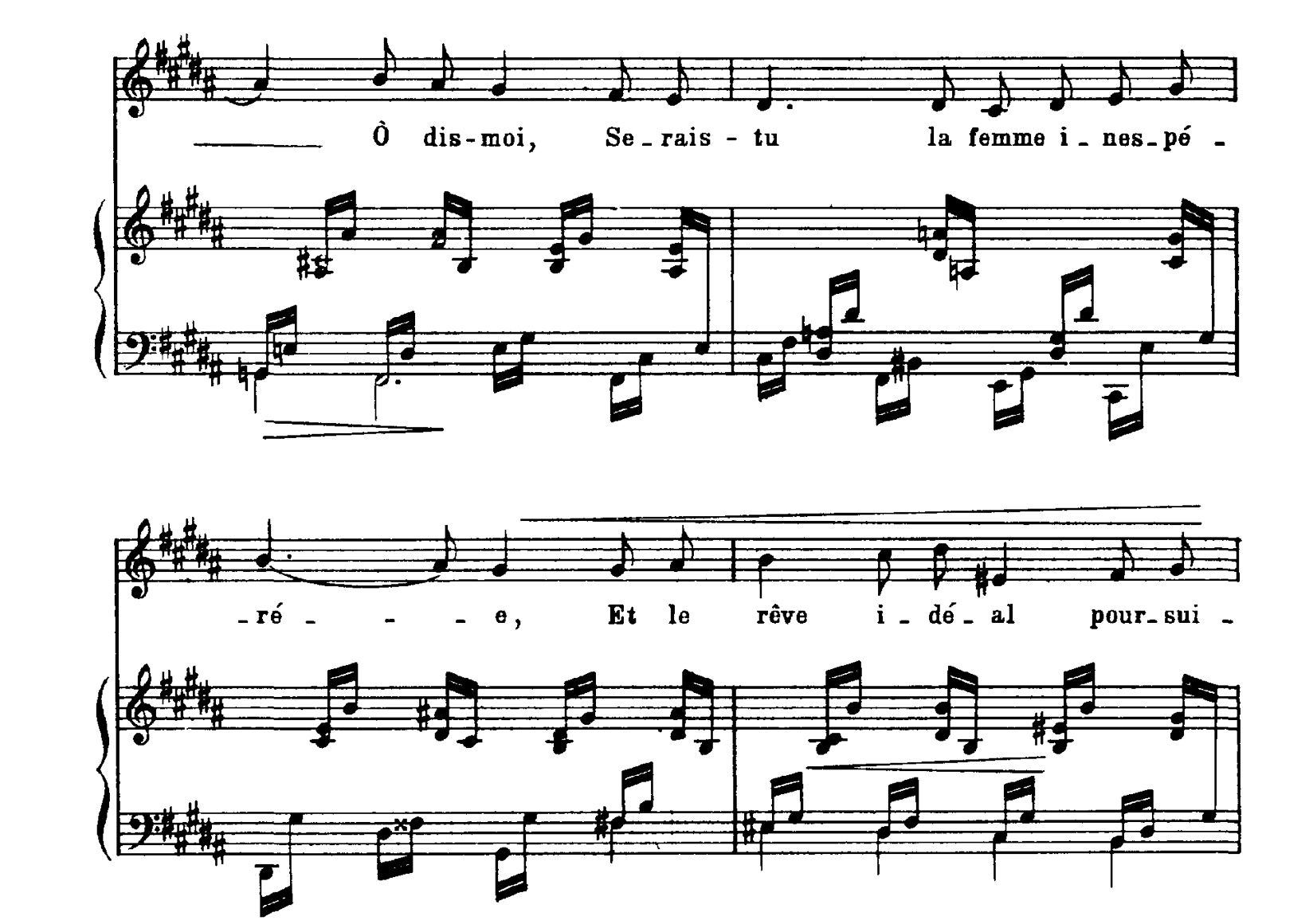
Fauré-Rencontre

We pronounce the text as follows: [o di mwa səˈrɛ ty la fam͜ inespeˈreə]

The word femme is also pronounced with an [a], as you will hear in the following clip at 18 seconds into the recording:

Barbara Hendricks and Michel Dalberto

The Verb Faire:

Commonly mispronounced, the verb faire , meaning “to do” in English, also happens to be one of the most common verbs used in the French language and poetry. There is also a particular pronunciation of the root of the verb in some conjugated forms.

For example, in most tenses of the verb, the -ai- component of the word is pronounced as an open [ɛ] as one would expect. The spelling also totally changes in some of the rarely used tenses, and there is even no root word “fai” anymore. Regarding the -ai- sounding utterly different than what it looks like, here is a list:

PRESENT: je fais [fɛ] tu fais [fɛ] il/elle fait [fɛ]  nous faisons [fœˈzõ]
vous faites [fɛtə]
ils/elles font [fõ]

IMPERFECT: je faisais [ˈzɛ] tu faisais [ˈzɛ] il/elle faisait [ˈzɛ] nous faisions [ˈzjõ] vous faisiez [ˈzje ]
ils/elles faisaient [ˈz ɛ ]

Notice that in the first person plural of the present tense and all of the imperfect conjugation, the verb’s -ai- sounds like [œ].

In the following text from Duparc’s La vie antérieure we find the text: “Le secret douloureux qui me faisait languir” we see two -ai- syllables, and one could assume that they sound the same, but this is the imperfect form of the verb “faire”..

Duparc-La vie antérieure

We pronounce the text as follows: [lə səˈkrɛ duluˈrø ki me fœˈzɛ lɑ̃ˈgir]

You can hear it clearly in the following clip at 3’19”:

José Van Dam and Maciej Pikulski

Eut

Yes, this is a word. In this case, it is a verb. If you have followed any French diction course, you should know that -eu- when it is the last sound in a word sounds as an o-slash [ø] unless the -eu- in question is part of the verb avoir (to have). When it is part of this verb, it sounds very different.

It can be in this form of the verb with an auxiliary:
J’ai eu (I have had) or in this form il eut (he had). It will still sound the same:

J’ai eu (I have had) [ʒe y]
Il eut (he had) [il y]

I have heard this word often turned into an [ø] or even an [œ]. When you translate your text, be sure to be alert and if it is a verb, use the appropriate pronunciation.

In the following clip, you can hear the proper way to sing this sound at 1’58”:

Véronique Gens and Roger Vignoles

A thing that I repeat to my non-native French-speaking students all the time is: “When pronouncing French, please don’t trust your instincts because they are probably incorrect. Stick to the rules and what you don’t know, ask a qualified French diction coach”. There are more words like the ones I have mentioned in this post, but these come back mispronounced, again and again, so memorize them, and you will be ahead of the curve!

Singing in French: Linking Words

“Sing everything like you are singing bel canto” is something I repeat frequently. Bel canto means “beautiful singing,” but it also means to sing everything with smooth phrasing and as legato as possible. Legato is the connected and uninterrupted production of sound, and it requires the singer to understand which vowels and consonants they are singing and how these relate to each other. How do you achieve this if you are not singing in Italian? More specifically, how do you accomplish this while singing in French? Without diving into the numerous French liaison rules, here is a quick explanation of three different ways you can link words in your French singing.

Vowels

The word vowel is taken from the Latin word vox, meaning voice. For singers, a proper understanding of all the vowels in every language t is at the top of the list of essential things to know. The unvoiced consonant stops or blocks the vowel completely, while the voiced consonant partially stops the vowel which causes an audible adjustment to the vocalic flow. Unlike English or German, French seems to run together with no clear separation between words, making French, much like Italian, a very singable language. The legato in the French language is the constant vowel flow within words and between words. This word-to-word flow is achieved by linking words to each other, known as “liaison.”

Here are three methods of linking up words in French:

1. Liaison

Liaison occurs when the usually silent final consonant is pronounced because it is followed by a word starting with a vowel or a mute h. Please note, we never pronounce the “h” sounds in French as we do in English (like in the word “hat.”) For more on the h in French, click here as I have dedicated an entire blog post to this letter, which is not pronounced in French, ironically.

Example:

Elle est arrivée avec un homme (She arrived with a man) [ɛl‿ɛt͜͜͜͜ ariˈve aˈvɛk‿ œ̃n‿ɔmə]

Notice that the t of est and the n of un are in liaison with the following vowels. Usually, these final consonants would be silent (see example below).

Example: Il est venu avec un cadeau (He came with a gift) [il‿ɛ vəˈny avɛk‿œ̃ kaˈdo]

The t of est is now silent as is the of un because consonants instead of vowels follow them.

The singer, working with liaison, should make the now sounded consonant rapidly and quite late because we don’t want to emphasize the liaison. It should also not alter or shorten the vowel preceding it. The use of liaison is more present in lyric diction rather than in spoken French. In everyday speech too much use of liaison makes someone sound quite stiff and old-fashioned. There are quite a few rules related to liaison; some are optional, some are mandatory, and some are forbidden. In some cases, a wrong liaison (for example, making a sound instead of a t) or choosing not to make a mandatory liaison can demonstrate a lack of taste or education.

When using liaison, be aware that some phonetic changes occur with the consonant affected.

  • The s becomes a z: Les amis (the friends) []
  • The d becomes a t: Le grand arbre (the tall tree) []
  • The x becomes a z: Deux amis (two friends) []
  • The f becomes a v: Neuf heures (nine hours) []

Be sure not to get confused with these phonetic changes as they should not change the word’s meaning.

Example :

Sans amour (without love) [sɑ̃z‿aˈmur]

Sens exatasié (senses in extasy)[sɑ̃s‿ɛkstɑˈzje]

As we can see, in the first example, the liaison from the in the word sans meaning without the s is always silent, but in the second example, we always pronounce the s in the word sens meaning senses; we are just linking the words to each other.

2.Elision

Elision is the omission of a final, unstressed -e in a word followed by a word beginning with a vowel or a mute h.

Example; Elle est assise depuis une heure (She has been sitting for an hour) [ɛl‿ɛt‿aˈsizə dəˈpɥiz‿yn‿œrə]

Here we make elision on the final e of elle because the following word, est ,starts with an e, so the l of elle is sounded right before the word est. Elision is commonly used both in lyric diction and in everyday speech.

  1. LINKING UP or “enchaînement”

Linking up or enchaînement occurs when we pronounce the final consonant, whether a vowel follows it or not. It is neither an elision or liaison, and it happens pretty naturally in singing and speaking.

Example il est ici (he is here) [ilɛt‿iˈsi]

The link between il and est is just that, a link. You do not need to show the link in your IPA translation only from a liaison or an elision.

Optional Liaisons

As you get more familiar with liaison, you will have the knowledge needed to opt-out of some liaisons that seem excessive. To quote Pierre Bernac (see below), who was an authority on “French Mélodie”: “There are a great number of cases when the liaison is optional, and left to the taste of the performer.” However, for a singer to know when they can leave out a liaison, they must have a thorough knowledge of singing in French.

Consulting a French Lyric Diction coach or an excellent French diction manual will be the best course of action rather than asking a friend who speaks French. Everyday French does not necessarily require the knowledge of the relatively large set of rules used for singing in French. There are many things to consider when singing in French, so always make sure you cover all your bases.

Did you know:

An excellent book to start building your library is The Interpretation of French Song by Pierre Bernac. He explores the musical analysis and suggested liaisons in the texts to help you find your way with French Mélodie.

Pierre Bernac (12 January 1899 – 17 October 1979) was a French singer, a baryton-martin, known as an interpreter of the French mélodie. He had a close artistic association with Francis Poulenc, with whom he performed in France and abroad. Poulenc wrote 90 songs for him during their 25-year musical partnership.

Bernac was well known as a teacher; among the singers who studied with him were Elly AmelingGrace BumbryMattiwilda DobbsCarol NeblettJessye Norman, and Gérard Souzay. He gave masterclasses in France, Britain and the US.

 Bernac wrote two highly regarded books about the interpretation of mélodies in general and Poulenc’s in particular.

Pierre Bernac – Wikipedia. https://en.wikipedia.org/wiki/Pierre_Bernac

A Look at the Yod a.k.a the J-Glide

A common point of confusion in French Lyric Diction is knowing when to pronounce the -ill(es), -il(s) as a Yod [j], and when do we pronounce this double “ll” combo as just one “l” [l]. There is a method to this madness, and it is not so complicated.

If the term”Yod” or “j-glide” is stumping you, you can check out one of my past blog posts on the subject of semi-consonants to catch up!

First, we should look at when we pronounce “i” as a Yod.

i or ï is pronounced as a [j] when preceded by a single consonant when it is in front of an a, e, o, or eu. Beware: not when it is in the middle of a word -ie- in some verbs and their derivatives or as the last sound of the word -ie.

For example:

Avant de quitter ces lieux, sol natal de mes aïeux (Before leaving this place, native soil of my ancestors), Valentin’s aria from Faust by Gounod

[aˈvɑ̃ də kiˈte sɛ ljø sɔl naˈtal də mɛz‿aˈjø]

In the example above, in the words “lieux” and “aïeux”, the i and ï are pronounced as a glide. Both of these vowels are in front of eu.

But we do not make a glide in the future tense conjugation of verbs like “oublier” (to forget) [ubliˈe]

J’oublierai (I shall forget) also does not have a glide; in fact, the e vanishes in pronunciation. I often hear [ʒubliəˈre], but the correct way to pronounce this word and other words like it is: [ʒubliˈre]

When -ie- is at the end of a word, it is simply [i] unless the composer gave a note value to the schwa, in which case it will be [iə], and we should not hear a glide between these vowels.

il, ill, ll : When do these letters make a Yod?

  • il, ill, and ll make a glide when at the end of a word in the following combinations: -ail,-eil, -ueil, -oeil- and euil.
  • il sounds as a glide in the middle of words in the following combinations: -aill-, -eill-, -euill-, -ouill-, -ueill- and oeill otherwise, it is pronounced as [ij].

Examples:

Un deuil amer (bitter mourning) [œ̃dœj‿aˈmɛr]

but in the word fille, we add an [i] in front of the glide; otherwise, there would be no vowel in the word: jeune fille (young girl) [ʒœnə fijə]

List of Exceptions:

As anyone who has ever studied the French language or French diction knows, there are many rules to follow, but there are just as many exceptions to the rules, if not more.

When il(s) is at the end of a word and follows a consonant, the i is [i], and the l is sometimes silent and sometimes sounded.

The following is pronounced without an l or a glide.

  • gentil (nice) [ʒɑ̃ˈti] N.B: You should not confuse this gentil with its feminine version gentille [ʒɑ̃ˈtijə] which is pronounced with a glide.
  • fusil (gun) [fy’zi]
  • grésil (hail) [gre’zi]
  • sourcil (eyebrow) [sur’si]

The following is pronounced without a glide but with an l

  • cil (eyelash) [sil]
  • fil (thread) [fil] or fils [fil] (the plural form of thread and pronounced exactly the same as the singular form) and not to be confused with fils (son or sons) [fis], which is pronounced without an l, but with an s whether it be singular or plural.

You could memorize this list, consult a French dictionary for the IPA translation on these more special words, or refer back to this post.

The exception also applies to the ll in the following words and their derivatives:

  • mille (thousand) [milə] Derivatives: million, milliers, milliards…
  • ville (city) [vilə] Derivatives: village, villageois, villagoise
  • tranquille (tranquil) [trɑ̃ˈkilə] Derivatives: tranquillité, tranquillement

If you don’t want to forget, memorize this phrase: Milles villes tranquilles: “A thousand tranquil cities” then you will remember that every word belonging to the family of these three words in French are pronounced as [l] rather than a [j].

These tips should help you navigate the world of “glide or not to glide” when it comes to the YOd and how to avoid making mistakes while singing, or speaking!

My favorite French dictionary online

We don’t always have a dictionary in our pockets, and let’s face the fact that we are in a digital age, no matter how much we love actual books. My favorite French dictionary online is the Larousse: https://www.larousse.fr/ This dictionary has been my go-to since as long as I can remember, it has it all, and the online version is quite good to work with.

How to Sing the French Mixed Vowels

The French language has fifteen vowel-sounds. I say this every year at the start of my French Lyric Diction class as the students’ eyes widen. I can almost hear them thinking “Fifteen? How is that possible? How can I sing fifteen different vowel sounds?” That seems like a lot and it can be quite daunting if you are a singer starting out singing in this language. The three vowel-sounds that I would like to focus on in this little French Lyric Diction post, are the three mixed vowel-sounds [œ] [ø] and [y].

When I say “vowel-sound” I don’t mean a pure vowel. The vowels we all know from when we first learn how to read are a, e, i, o, and u. Think of all the french vowel-sounds as derivatives of these. Some vowel sounds are even based on the derivatives of the derivatives. A mixed vowel is when you take two characteristics of two different vowels and as you combine them you create a whole new vowel. They are called “mixed” because their formation is dependent on the simultaneous positioning of the tongue and the lips.

In the chart above, we see the vowels in the tongue position, and the vowels in the lip position, in the middle are the mixed vowels.

The Phonetic [y] vowel-sound:

  • Phonate the [i] sound, as in the French word “midi” [miˈdi] (noon) or if you wish to come from the English language the [i] in the word “we”.
  • Now, sustain this [i] sound, as you do so, form your lips to the shape of a closed [o] as in the word “rose” [rozə] in French (or English) all the while not changing your [i] tongue position.
  • You now magically have the phonetic [y] vowel as in the French word “lune” [lynə] (moon).

The o-slash vowel:

  • Phonate an open [ɛ] as in the French word “tête” [tɛtə] (head) or from the English language, the word “feather”
  • Again, sustain this [ɛ] and as you do so, form your lips to the shape of a closed [o] while not changing your tongue position.
  • You now are making the sound of [ø] as in the word “feu” [fø] (fire).

The o-e vowel is a little different:

  • Start out in the same way you did with the o-slash: phonate on an open [ɛ].
  • While sustaining this vowel, you will form your lips into an open [ɔ] as in the French word “homme” [ɔmə] (man) or from the English you can think of the word “on”. So this is less of a closed [o] formation than we used above. (If it starts sounding like [ø], turn back you have gone to far towards a closed vowel with your lips!)
  • You now have a perfect o-e vowel, and you can now perfectly sing the word “coeur” [kœr] (heart)
  • Nota bene: the Schwa [ə] sound is equivalent to the [œ]. They have the same sound, the difference is that the schwa can never be stressed while the [œ] can be stressed. Example: émeute [eˈmøtə] (riot) while singing this word, the stress is on the o-slash and you would sing the schwa unstressed if it has a note value.

As you sing, if you think about the vowel that you are making with your tongue and just adjust your lips, you can avoid going too far between sounds, and your singing and legato will feel easier, especially depending on the tessitura in which you are singing.

Example:

Intonate these words, all the while keeping your tongue in the [i] position while forming your lips into a closed [o] when reading words with [i] or [y] sounds.

Tu dis qu’il a une fille unique. (You say that he has an only daughter.)

[ty di kil a ynə fij ynikə]

Looking at the phonetic transcription, you have only 2 vowels ([a] and [i]) and two vowel-sounds ([y] and [ə]). The [y] and [i] are the ones you want to practice here. Glide to and from these vowels, see how it feels to not change the tongue position. Try it on different pitches to practice. Do the same with the other mixed-vowels until you master singing them, it will feel easier and your voice will most definitely respond!

Singing in French can be a very scary thing. I am not going to lie to you and tell you that it is easy. But with a few tools, it can definitely be more singer-friendly and as you practice, you will really learn to enjoy singing in this beautiful language.