Looks are deceiving: Special French Words

After years of coaching French repertoire, I have come across some difficult words which people struggle to pronounce, unless you know how to say them. There is no way to figure them out unless you are a native speaker. Pronouncing these words cannot be solved with diction rules or IPA (International Phonetic Alphabet). Let’s look at three of these particular words and some contexts where you can find them.

Solennel

The word Solennel meaning Solemn in English, is often used in French poetry. It looks like we pronounce it a certain way, but it is not what you think. Let’s dissect this word:


If we use our knowledge of French diction rules, it may look like we pronounce it as [sɔlɛˈnɛl]. If we are unaware that nasal vowel sounds when followed by another n loses the nasal quality and returns to its original sound (for more on this rule, see my previous blog post), the temptation is to add an [ɑ̃] in there to cover all of your bases.

However, this would be the wrong way to say this word. In the following excerpt from Fauré’s Cinque mélodies de Venise we find this word in “Et quand, solennel, le soir…”

Fauré -En sourdine

We pronounce the text as follows: [e kɑ̃ sɔlaˈnɛl lœ swar]

Yes, you saw it correctly; that is an [a] in there. This word has gone through some spelling changes over time, which is why you sometimes still (although rarely) see it spelled solemnel. Even with this older spelling, the word is still pronounced [ sɔlaˈnɛl]. In the following clip, you can hear its correct pronunciation at 2’10”:

Gérard Souzay and Jacqueline Bonneau

Femme:

The word femme, meaning woman, is also one of these abnormal words which looks one way and sounds another way! When we pronounce the word in English as it is written in French when we use expressions such as “Femme Fatale”, which can sound like “fem fuh·taal“, but beware, this is not how this word sounds in French! In the following example from Fauré’s Rencontre, we find this word in the text: “Ô dis-moi, serais-tu la femme inespérée…”
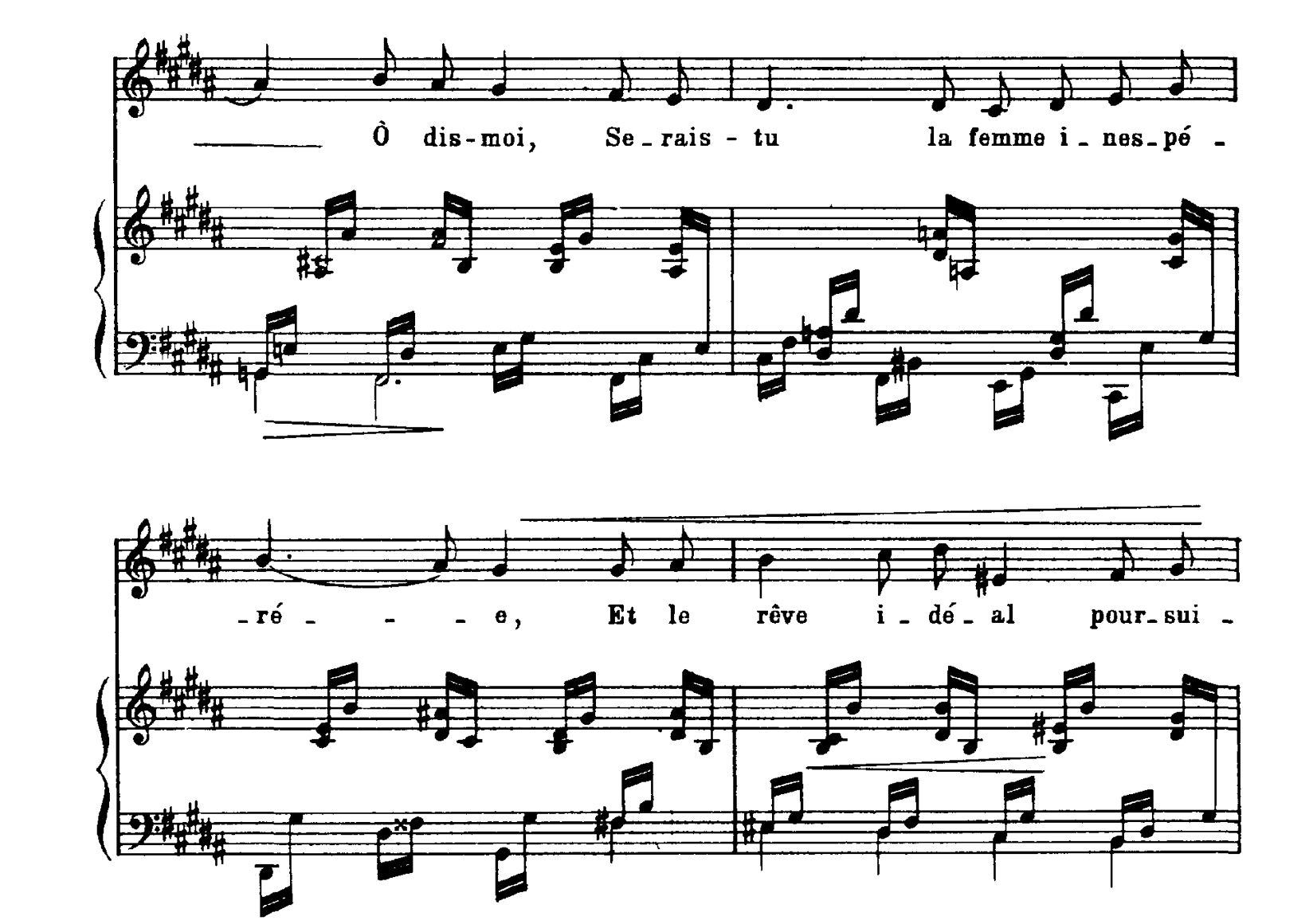
Fauré-Rencontre

We pronounce the text as follows: [o di mwa səˈrɛ ty la fam͜ inespeˈreə]

The word femme is also pronounced with an [a], as you will hear in the following clip at 18 seconds into the recording:

Barbara Hendricks and Michel Dalberto

The Verb Faire:

Commonly mispronounced, the verb faire , meaning “to do” in English, also happens to be one of the most common verbs used in the French language and poetry. There is also a particular pronunciation of the root of the verb in some conjugated forms.

For example, in most tenses of the verb, the -ai- component of the word is pronounced as an open [ɛ] as one would expect. The spelling also totally changes in some of the rarely used tenses, and there is even no root word “fai” anymore. Regarding the -ai- sounding utterly different than what it looks like, here is a list:

PRESENT: je fais [fɛ] tu fais [fɛ] il/elle fait [fɛ]  nous faisons [fœˈzõ]
vous faites [fɛtə]
ils/elles font [fõ]

IMPERFECT: je faisais [ˈzɛ] tu faisais [ˈzɛ] il/elle faisait [ˈzɛ] nous faisions [ˈzjõ] vous faisiez [ˈzje ]
ils/elles faisaient [ˈz ɛ ]

Notice that in the first person plural of the present tense and all of the imperfect conjugation, the verb’s -ai- sounds like [œ].

In the following text from Duparc’s La vie antérieure we find the text: “Le secret douloureux qui me faisait languir” we see two -ai- syllables, and one could assume that they sound the same, but this is the imperfect form of the verb “faire”..

Duparc-La vie antérieure

We pronounce the text as follows: [lə səˈkrɛ duluˈrø ki me fœˈzɛ lɑ̃ˈgir]

You can hear it clearly in the following clip at 3’19”:

José Van Dam and Maciej Pikulski

Eut

Yes, this is a word. In this case, it is a verb. If you have followed any French diction course, you should know that -eu- when it is the last sound in a word sounds as an o-slash [ø] unless the -eu- in question is part of the verb avoir (to have). When it is part of this verb, it sounds very different.

It can be in this form of the verb with an auxiliary:
J’ai eu (I have had) or in this form il eut (he had). It will still sound the same:

J’ai eu (I have had) [ʒe y]
Il eut (he had) [il y]

I have heard this word often turned into an [ø] or even an [œ]. When you translate your text, be sure to be alert and if it is a verb, use the appropriate pronunciation.

In the following clip, you can hear the proper way to sing this sound at 1’58”:

Véronique Gens and Roger Vignoles

A thing that I repeat to my non-native French-speaking students all the time is: “When pronouncing French, please don’t trust your instincts because they are probably incorrect. Stick to the rules and what you don’t know, ask a qualified French diction coach”. There are more words like the ones I have mentioned in this post, but these come back mispronounced, again and again, so memorize them, and you will be ahead of the curve!

A Look at the Yod a.k.a the J-Glide

A common point of confusion in French Lyric Diction is knowing when to pronounce the -ill(es), -il(s) as a Yod [j], and when do we pronounce this double “ll” combo as just one “l” [l]. There is a method to this madness, and it is not so complicated.

If the term”Yod” or “j-glide” is stumping you, you can check out one of my past blog posts on the subject of semi-consonants to catch up!

First, we should look at when we pronounce “i” as a Yod.

i or ï is pronounced as a [j] when preceded by a single consonant when it is in front of an a, e, o, or eu. Beware: not when it is in the middle of a word -ie- in some verbs and their derivatives or as the last sound of the word -ie.

For example:

Avant de quitter ces lieux, sol natal de mes aïeux (Before leaving this place, native soil of my ancestors), Valentin’s aria from Faust by Gounod

[aˈvɑ̃ də kiˈte sɛ ljø sɔl naˈtal də mɛz‿aˈjø]

In the example above, in the words “lieux” and “aïeux”, the i and ï are pronounced as a glide. Both of these vowels are in front of eu.

But we do not make a glide in the future tense conjugation of verbs like “oublier” (to forget) [ubliˈe]

J’oublierai (I shall forget) also does not have a glide; in fact, the e vanishes in pronunciation. I often hear [ʒubliəˈre], but the correct way to pronounce this word and other words like it is: [ʒubliˈre]

When -ie- is at the end of a word, it is simply [i] unless the composer gave a note value to the schwa, in which case it will be [iə], and we should not hear a glide between these vowels.

il, ill, ll : When do these letters make a Yod?

  • il, ill, and ll make a glide when at the end of a word in the following combinations: -ail,-eil, -ueil, -oeil- and euil.
  • il sounds as a glide in the middle of words in the following combinations: -aill-, -eill-, -euill-, -ouill-, -ueill- and oeill otherwise, it is pronounced as [ij].

Examples:

Un deuil amer (bitter mourning) [œ̃dœj‿aˈmɛr]

but in the word fille, we add an [i] in front of the glide; otherwise, there would be no vowel in the word: jeune fille (young girl) [ʒœnə fijə]

List of Exceptions:

As anyone who has ever studied the French language or French diction knows, there are many rules to follow, but there are just as many exceptions to the rules, if not more.

When il(s) is at the end of a word and follows a consonant, the i is [i], and the l is sometimes silent and sometimes sounded.

The following is pronounced without an l or a glide.

  • gentil (nice) [ʒɑ̃ˈti] N.B: You should not confuse this gentil with its feminine version gentille [ʒɑ̃ˈtijə] which is pronounced with a glide.
  • fusil (gun) [fy’zi]
  • grésil (hail) [gre’zi]
  • sourcil (eyebrow) [sur’si]

The following is pronounced without a glide but with an l

  • cil (eyelash) [sil]
  • fil (thread) [fil] or fils [fil] (the plural form of thread and pronounced exactly the same as the singular form) and not to be confused with fils (son or sons) [fis], which is pronounced without an l, but with an s whether it be singular or plural.

You could memorize this list, consult a French dictionary for the IPA translation on these more special words, or refer back to this post.

The exception also applies to the ll in the following words and their derivatives:

  • mille (thousand) [milə] Derivatives: million, milliers, milliards…
  • ville (city) [vilə] Derivatives: village, villageois, villagoise
  • tranquille (tranquil) [trɑ̃ˈkilə] Derivatives: tranquillité, tranquillement

If you don’t want to forget, memorize this phrase: Milles villes tranquilles: “A thousand tranquil cities” then you will remember that every word belonging to the family of these three words in French are pronounced as [l] rather than a [j].

These tips should help you navigate the world of “glide or not to glide” when it comes to the YOd and how to avoid making mistakes while singing, or speaking!

My favorite French dictionary online

We don’t always have a dictionary in our pockets, and let’s face the fact that we are in a digital age, no matter how much we love actual books. My favorite French dictionary online is the Larousse: https://www.larousse.fr/ This dictionary has been my go-to since as long as I can remember, it has it all, and the online version is quite good to work with.

Vocalic Harmonization in French Singing

What is Vocalic Harmonization?

Maybe you have heard this term before, or perhaps it is new to you. When I coach people for the first time, it always seems like they are familiar with Vocalic Harmonization, but they are not sure how to use it. It is a term used in linguistics when applying the rhyming of closely related vowels in the same or words that follow each other. It is also known as “vowel harmony”. The practice of vocalic harmonization is most often used in the French vocal repertoire for linguistic refinement and ease of vocal production. Most frequently in French singing, we harmonize [ɛ] with [e] and [œ] with [ø]

For example:  “aimer” [ɛˈme] becomes [eˈme] or Heureux [œˈrø] becomes [øˈrø]

As you can see in the examples above, the unstressed, open vowel-sound closes to rhyme with the following stressed, closed vowel, not the opposite. Remember, it is the final syllable that is stressed in French, except when that syllable is a schwa-sound [ə] because a schwa can never be stressed. In this case it is the syllable before the schwa that gets the stress.

les, tes, ses, mes, ces…

the possibility of vocalic harmonization also exists in closing the [ɛ] in short words such as les, tes, ces, etc. (these are articles or possessive adjectives). When a closed vowel immediately follows these, they can be closed to an [e].

For example: les étés [lɛz‿eˈte] would become [lez‿eˈte]

The article “les” is harmonized to the closed [e] in “étés”

These harmonized syllables must never be accented or overly closed, and at times they only are slightly closed on the way to their closed neighboring vowel-sound, and over-closing the harmonized vowel can result in obscuring the text. The idea is that it should feel natural and sound authentic since vocalic harmonization occurs in everyday speech but not deliberately. Many native French speakers do not even realize that they are doing this.

Some French words are almost always harmonized. For example, the following words would have all open vowels in the first syllable if we followed the diction rules, but they are sung and spoken with vocalic harmonization:


aimer (to love) [ɛˈme] becomes [eˈme]
baiser (to kiss) [bɛˈze] becomes [beˈze]
heureux (or heureuse) (happy) [œˈrø] becomes [øˈrø]


Vowel harmonization should not be systematic. It is a completely optional choice left to the singer. In cases where it can help the legato line, it is recommended to harmonize the vowels as sometimes it is easier to get through a phrase with fewer vowel changes.

For example:

Let’s take a look at “Lydia” by Fauré. In this text we find this line: “Laisse tes baisers de colombe”

The “tes baisers” can be sung as all closed [e] but the “laisse”” remains an open [ɛ] because the vowel following it is not a closed vowel.

[lɛsə tɛ bɛˈze] becomes [lɛsə te bɛeze]

Speak it out loud both ways and see the difference for yourself.

I would also go further and say if you have an article or possessive adjective (les, des, mes, tes ses) and the following word begins with a closed [o] or any vowel that has a closed feeling such as [i], [ø] [õ] [y] or [o], you can apply vocalic harmonization.

Again in in “Lydia by Fauré:

“Lydia, sur tes roses joues” you can harmonize the “tes” which would typically be [tɛ] to a closed [te] to match the closed [o] sounds of [rozə]. But, the “mes” in “mes amours” in the same song stays [ɛ] because a closed vowel-sound does not follow it.

Here is the text of Fauré’s Lydia where I will highlight the vocalic harmonizations:

Lydia, sur tes roses joues
Et sur ton col frais et si blanc
Roule étincelant
L’or fluide que tu dénoues;
Le jour qui lui est le meilleur
Oublions l’éternelle tombe
Laisse tes baisers de colombe
Chanter sur ta lèvre en fleur.
Un lys caché répand sans cesse
Une odeur divine en ton sein;
Les délices comme un essaim
Sortent de toi, jeune déesse
Je t’aime et meurs, ô mes amours,
Mon âme en baisers m’est ravie
O Lydia, rends-moi la vie,
Que je puisse mourir toujours!

In this recording of Véronique Gens and Roger Vignoles, you can hear the use of vocalic harmonization as highlightede above.

Véronique Gens and Roger Vignoles

Try not to over-use vocalic harmonization. Remember, it should not obscure the text, and it should be helpful to the singing. If you are not sure if something should be harmonized or not, ask your French diction coach, or listen to several recordings to see what the consensus is. Just know that some coaches don’t apply vowel harmony and there are differing opinions on the matter. Since it happens in everyday speech, and I have seen it help so many singers in their legato and ease of singing, I generally encourage vocalic harmonization when appropriate.

Choosing Your Vocal Coach-Pianist

Singers, maybe more than anyone else in the performing arts, are bombarded with people giving them their opinion on the way they sing. Everyone seems to have something to say, and they regularly voice their opinion to the singer whether or not the singers wants to hear it. Because singers are not technically able to hear themselves when they sing, it is easy for them to fall into the trap of believing all these opinions. All day long, singers are put in situations where they are set up to receive feedback. The conductor gives them comments, the stage director and/or the stage manager gives them comments, the diction coach gives them comments, the coach gives them comments, the teacher gives them comments, and when they perform, the audience and the critics give them comments. Those are a lot of COMMENTS. This is just a normal day in the life of a singer. It is important for singers to surround themselves with a team of people they trust completely to help them weed through all of the comments and all the outside “noise”. A good coach is a great help in figuring out which feedback is useful.

The coach

What is a pianist-coach? A pianist-coach is a skilled pianist who specializes in vocal coaching. Mostly we know them as coach, opera coach, vocal coach or collaborative pianist. You see your coach regularly, you trust them, you let them see you in the beginning of your process and they stay with you until you are ready to step onto the stage.

There are different types of pianists who specialize in working with singers. You can collaborate musically with a pianist by being both equal partners, you share your musical vision, prepare recitals and recordings together. This is when when the pianist plays the role of a “collaborator” or a “recital partner”. There are also “rehearsal pianists” who you call when you want to run through repertoire without much or any input. You just want to repeat things ad nauseum until you feel ready. Sometimes, a coach can play that role as well, mostly after the preparation is complete and the singer is about to start the job. A coach is not someone who will teach you your notes and rythm. There are pianists who do that, and sometimes singers do need this kind of help, but this is not a coaching, it is more like a practice session, or what is commonly called a “note-bashing” session. Most coaches do not want to do this. “Spoon-feeding” is considered a waste of resources, so don’t just show up expecting your coach to do this. If you are a singer who needs this from your session, you can kindly ask the coach first if they would agree to doing this kind of work, and if they don’t, then ask another pianist you know for a session (often younger pianists or students do this for extra earnings).

When you properly work with a true coach you can expect a more of a teacher-student type of relationship. They provide you with valuable feedback and information. You go to a coach when you want to prepare roles, work on recital repertoire in detail, work on language and text, work on your audition preparation, get to the finer points of character and the music.

Some things to consider when choosing a coach:

  • Your relationship with your coach is an intimate one, so most importantly, find a coach that you like as a person. The work you will be doing will be intense. It demands a lot of trust from both sides. You should feel comfortable making mistakes, and they should make you feel comfortable about being corrected.
  • Find a coach who meets your skill level. If you are an experienced singer, find a coach who has been working in the field for at least the same amount of time as you have, but preferably they should have more experience.
  • When you sing repertoire which is advanced, you want your coach to be able to play it (or at least sight-read it well) and make comments on what you are doing in order for you to improve. If a coach does not know your repertoire, they should not pretend to know it. When I am confronted with unfamiliar repertoire, I am honest about it, I still work on it, but the next time I see the singer, I have learned it. If you are doing something that you suspect is unknown, giving a heads-up is a good idea.
  • A coach, should have excellent pianistic skills, they should inspire you to sing and make music, and if you are singing opera, they should be able to conjure up an orchestra from the keys! My favorite compliment is always: “You play like a full orchestra!” This does not mean loud and “bangy”. Playing “like an orchestra” is about the texture of the sound and supporting the singer fully.
  • A coach should have quite advanced language skills, they should be able to speak or at least have a firm grasp of the lyric diction in a minimum of four operatic languages: French, English, Italian and German. Their ear should be developed enough to hear even very subtle language inaccuracies.
  • Find a coach who understands style and tradition, as well as current trends in performance practice. Whether you bring bel canto, baroque, romantic or contemporary music, your coach is well versed in all of the styles in order to guide you.
  • If you are preparing a role, it is of the utmost importance that your coach is able to play the score while singing all the other parts. It does not have to be beautiful singing (trust me!) but it should be audible. If your coach can’t do this, and you have a role coming up, find one who can.
  • Your coach is not your voice teacher. A coach can support your vocal technique, but please do not go to a pianist to learn how to sing, or to get vocal technique. This is what a voice teacher is for. Confused? See this previous blog post: A Voice Teacher and a Vocal Coach-Why you need both! A good coach who has years of experience working with singers will be able to point out something that needs technical attention, and then suggest that the singer address the issue with their voice teacher.
  • When you work with a coach, they can also be your collaborative partner. If you have musical chemistry with your coach on all levels, then by all means collaborate with them on stage, too!
  • It is important that a coach treats you like a person. Yes coaches teach, but you should feel comfortable in your session, not only with the singing, but with making a contribution to the session. A good coach asks questions, wants to know what the singer’s opinion is on the music, text and character, after all, you are the one who is singing it! If you feel like your coaching is a one way street, find a coach who lets you get a word in edgewise.
  • The coach you work with makes you feel respected. They are on time and they should not cancel at the last minute (unless it is an emergency…it can happen…but not regularly) and you should do the same for them.
  • Look for a coach who has worked with great conductors, organisations, opera houses and singers. They will have first-hand knowledge of what is needed in the world in which you aspire to work. That being said, do not expect that by working with someone attached to a house, that they will get you auditions, work or any kind of exposure to where they work. When singers come to a coaching with the idea that they can get a contact, audition or a job from the coach they are working with, it is very obvious. Believe me, we spot it from a mile away.
  • Finally, the coach (or coaches) you choose to work with are accessible, you should feel like you can approach them for advice and have confidence that they will be honest with you. A coach who only tells you what you want to hear is not a coach you need. There is no time to waste and honesty will help you improve, even if it doesn’t always feel great to hear the truth. A good coach will tell you what you need to hear, not necessarily what you want to hear!

Coaching fees-How much should you be paying?

I think every coach needs to come up with a fee that represents what they think their time is worth. Other than the points mentioned above, the following can help you along as you are considering hiring a coach:

  1. Level of education and/or experience: The longer someone has been working as a coach, the more knowledge they have to share. You are basically paying for their experience and knowledge. As you record your session (always ask first if it is permitted. If not, take tons of notes!), you will be able to refer back to the session for the rest of your life. You will, in turn, most likely use the acquired information in your own teaching and get payed for it yourself in the future!
  2. Repertoire: With experience, comes a vast knowledge of repertoire. Imagine how many hours the coach in question has spent behind the piano learning repertoire over the years. There is no way they are really breaking even financially!
  3. Supply and demand: Prices can vary depending on if they are in demand. Some coaches prefer a lower fee and work with many singers, and other coaches like a higher fee and fewer singers.
  4. The bundle: Some coaches like to bundle, meaning that if you take several sessions, they will give you a lower price. You can ask if they have something like this available where you book a certain amount of coachings ahead of time.
  5. Student prices: If you study at a school, hopefully they provide a coach, if not, ask about a student fee. Most coaches won’t charge a student the same price as someone already in the profession.
  6. Online sessions: With the corona-crisis, we are now being more open to the possibility of online coaching. This means that coaches can open up their studios world wide. It is still early days, but maybe there is a different fee depending on what is offered. As the technology develops, we will see how far this can go, but it is an exciting development. It means the planet is a little smaller and you can work with people who are on another continent!

You are paying for advice and expertise and you want the best help you can get in order to do the best you can do. If it feels too expensive, then find someone that is more affordable for you. Ask around and see what the rates are. Every country, city, region has a going rate so answers will vary depending on where you are. I don’t advise haggling on the price of a session. Everyone who offers private coaching has thought long and hard about their fee and it is not customary to try and bargain.

As you go on in your professional career, you can and will work with more than one coach, you can have a list of different coaches for different aspects of what you are working on. Some coaches have specific strenghts that stand out of their vast skill set. When you are a professional singer, you will sing everywhere and have a list of coaches for all the cities where you work-a set of ears you trust everywhere you go!

When Does a Nasal Vowel Lose its Nasalization?

The four French nasal vowel sounds

If you have taken any French diction course in your life, you know that in French there are 36 sounds to master and 15 of them are vowel sounds (and then you have 18 consonant sounds and 3 semi-consonant sounds). The most misunderstood of all French sounds is the “nasal” vowel sound. In the French language there are four:

  • [ɑ̃] which is based on the french “dark a” sound as in the word “âme” (which means soul)
  • [õ] which is based on a “closed o” sound like in the word “hôtel” (which means hotel)
  • [ɛ̃] which is based on an “open ɛ” sound like in the word “mais” (which means but)
  • [œ̃] which is based on the “o e” sound like in the word “chacun” (which means each)

When I say it is “based on”, I mean that the basic vowel takes up approximately 85 -90 percent of the nasal sound, depending on tessitura, and the rest is resonance which passes through the cavities that are found near the nose, in the yawn space, more or less in the center of your head, but not in your nose.

The reason a nasal vowel is called as such is because the consonants which follow the vowel in question are the nasal consonants n and m. In order to produce these consonants, you must pass through your nasal cavity. That being said, you should not pronounce the m or n in a nasal sound unless it is in a “liaison*”. The combination of a vowel plus the nasal consonant is why they are known as “nasal vowels” and not because they belong in your nose. The m or n that follows every nasalized vowel-letter is silent. A nasal vowel is just that, a vowel. It is not a vowel-plus-a-consonant, a sort of m or n, or the faint “ng” sound which is nonexistent in French.

While singing, if someone wishes to sound “as authentic as possible”, they tend to over-nasalize the French nasal sound which results in a much less resonant sound-actually it can cut your sound in half leaving you feeling stuck. Thinking of the appropriate basic vowel, and focusing your attention on it while letting the resonance take care of the rest, will be more conducive to proper singing and will sound much less stiff to the listener whereas exaggerated over nasalization sounds a bit comical.


Now that we have had a brief look at how a nasal vowel functions, when does the vowel loose it’s nasalization?

Rule: Any vowel-letter(s) followed by m or n is usually nasalized unless the m or n is followed by:

1. a vowel-letter or a vowel sound in the same word.

Example:

immense (which means immense) [imˈɑ̃sə]. The double “m” takes away the nasal.

or

2. an m, n, or h in the same word.

Example:

bonheur (happiness) [bɔˈnœr]. Although the word “bon” is most definetly nasalized, the word “bonheur” is not.

So whereas the vowel-sound of the word “sein” [sɛ̃] (meaning breast) is nasalized the name of the river flowing through Paris, the ‘Seine’ [sɛnə], is not, since the n is followed by a vowel-letter.

Denasalization usually does not occur between words or words in liaison: mon amour (my love) [mõn ͜ amur] As you can see, even if the n is pronouonced because it is in liaison, the o stays nasalized.

Exception:

In these following instances, the nasal vowel stays intact even if the m or n is followed by another m or n:

emmener (to bring) [ɑ̃məˈne]-this word has a double m, but the nasal remains.

ennui (boredom) [ɑ̃ˈnɥi]-this word has a double n, but the nasal remains.

And remember what I said about this rule does not apply in liaison? There is an exception to that too (as there are exceptions to most French diction rules):

When you wish someone “Happy Birthday” in French, you say: “Bon anniversaire!”. The correct way to pronounce this is [bɔn ͜ anivɛrˈsair(ə)], without nasalization on the o or the a, but I notice that the pronunciation of this saying confuses the orthography and it is often wrongly spelled: bonne anniversaire. This of course cannot be, because “bonne” is the feminin form of the adjective “bon” and “anniversaire” is a masulin noun. So, we speak it one way, but it is written another way.

So the next time you want to write a message on your French friend’s social media, you can write “Bon anniversaire!” and you will know why we pronounce it differently than how it looks!🎂

*liaison: A liaison may occur only between a normally silent final consonant and an following vowel-sound. Ex: les ͜ amoureux (the lovers) [lɛz͜͜ ͜ amurø]

A Voice Teacher and a Vocal Coach- Why You Need Both!

Because singers hear themselves differently than the outside world, they need a team of experts around them to be their extra ears. Singers depend on others to let them know if what they are doing sounds right, if their diction is correct, and if they are actually doing what they are trying to do. Depending on others means that everyone will have an opinion about how you are singing and how you should be doing things. So, how do you know who you can trust? How do you assemble a trustworthy team to help weed through all the noise?

First, and in my opinion, most important, is a voice teacher. As a singer, you need someone who will go on your technical journey with you. This means someone with an in-depth knowledge of vocal technique and who knows how to communicate it in a way that you can understand. Vocal teaching is expressed through a language unique to each teacher and it can take time to understand what they are asking from you. Sometimes the technical work is excellent, but your personalities do not click. Can you work like this? Should you stay in this studio? Sometimes you get along on a personal level, but the technical gains are not happening-same questions apply. These are soul-searching questions and hard decisions, but the most important reasons to be with a teacher are making healthy vocal improvements, problem-solving, and maintaining a beneficial vocal technique. The outcome of your work is more important than just having a great time with someone during a lesson.

In addtion to a voice teacher, an excellent vocal coach who understands where you are coming from and where you are going is essential to any singer trying to have a career. It is important to note that a vocal coach is not a voice teacher. Though they may have the same goals for you, a vocal coach is usually a pianist which means there are no grounds for them to give you a full-blown voice lesson. I have been coaching singers for many years, and I have been in thousands (not exaggerating!) of voice lessons. As a vocal coach, I know many technical concepts, and I can identify what a singer is doing to produce a sound or if the sound is right or not, but that does not mean that I want to go in-depth with these technical concepts. My job is to support the technical work both singer and teacher are doing by understanding it and making musical and language adjustments that do not get in the way and often my adjustments may help technically, but this is just a by-product of my coaching. I may have some technical comments to make, and I do make them, but I am always careful not to steer the singer down the wrong path, and most importantly, I always try not to go against the technical road the singer is on with their voice teacher.

Voice teacher vs. Vocal coach

While both help you to improve your singing, there is a difference between each of the professions. Learning what they do will help you decide how to go about choosing the right people to be in your team.

• Voice Teacher

– Individually helps you to make the correct sounds, with proper pitch and tone

– Works on voice building and vocal registration

– Helps you develop your vocal skills, builds up your vocal production and chooses appropriate repertoire and roles.

– Lays the foundation to build your voice into its full potential and helps you to maintain your voice.

• Vocal Coach

– From the piano, they individually help (to coach) you on singing particular repertoire

– Focuses on style and diction – proper pronunciation of words, especially foreign languages

– Helps you interpret and perform your repertoire (works on character, meaning, sub-text – what does the song mean?)

– Along with your voice teacher helps you build your singing repertoire.

A vocal coach is a usually pianist who works almost exclusively with singers and who knows the repertoire. An excellent vocal coach won’t interfere with vocal technique, and if they notice any issues, they’ll explain to the singer what they think the problems are and recommend that the singer discuss it with their voice teacher.

More than one of each?

As you can see, the two functions at times cross over each other, but this should only be in support of each other. As you advance in your career, you may see your voice teacher less because you are traveling, and a weekly lesson is not possible anymore, and you end up checking in once or twice a month or when you start working on a new role. We are realizing, however, in this time of Covid-19 that voice lessons can really be productive in an online format if need be. But as you are working and travelling, an excellent vocal coach is vital component to your success. They will be your ears and let you know if something is not working. They can take you through your role and advise you on a multitude of issues. The best part is that you can have several trusted vocal coaches around the world. You don’t have to have just one, but with voice teachers, it can lead to confusion to have more than one-the equivalent to “too many cooks in the kitchen”- and in my years of experience, when I have seen singers try to have more than one voice teacher, it has rarely worked out if ever.

Can a Vocal coach be a Voice Teacher?

Some vocal coaches are neither voice teachers nor pianists. They are people with excellent knowledge of repertoire , style, convention, and integrating some technical concepts. They may call themselves voice teachers, but what they do is more like coaching. When you have a session with such a coach, you would normally have to bring a pianist and almost exclusively work on repertoire and not necessarily on voice building concepts.

Though singers can be coaches, I firmly believe that a pianist cannot be a voice teacher. If a singer or violinist offered me a piano lesson, I would be a little perplexed as they don’t have an in-depth knowledge of playing the instrument. Since most pianists have no real idea of what it is like to sing on stage or even sing at all (some of us can’t even produce a healthy sound), they should refrain from teaching someone how to sing even if they have some technical knowledge. There are pianists out there who have studied voice extensively, and they have sung in their life, and then if a singer chooses to work with a singing pianist and follow their technical advice, that is their choice to make, but these pianists are rare. Most pianists who work with singers have had some minimal voice training, but they are not voice builders, which is why my advice is to get your technique from the technical experts!

The bottom line is to know what you need and where to find it. Work with people who support you and each other because you don’t want your voice teacher and your vocal coach bickering all the time-Who needs that? Your number one priority is keeping your voice healthy and acheiving your musical goals!

As they say, “it takes a village” to develop great performers and artists and a great team is crucial to your development, so choose wisely!

What is a «tréma»?

The “tréma” and what it does

Technically, the trémaor diaeresis- is a diacritic sign made or two dots on top of a vowel. It used to be written like two accents (“), but is now written as two dots (¨).
If you know German, the tréma looks like the German umlaut and is known only as “tréma”, notaccent tréma”. The tréma can be found most often above E and I, it can appear over U and Y, but mainly in proper nouns for example: Louÿs. It is less common over O or A which would only occur in words borrowed from other languages. The tréma changes the pronunciation of French words. If you know your basic French phonetics/reading rules, you know that some letter combinations form a new sound, eg. “ai” = [ɛ], “oi” = [wa], etc. When the tréma is used, it means that you must distinctly pronounce the letter under it as well as the letter before and after it separately and you will also need to sound the last letter of the word if it follows the tréma. A tréma can also indicate that a vowel is silent as it applies to ancient spellings. For example in this famously mispronounced name of the French composer Saint-Saëns. The tréma over the E (ë)means that the letter is silent, so this name is pronounced [sɛ̃sɑ̃s] and yes, this is really how you pronounce it! The first syllable is the nasal [ɛ̃] sound as in the IN in the word matin (morning) and the second syllable is as the nasal sound [ɑ̃] as in the AN in the word maman (mother) and because it follows the tréma, the final S is pronounced!

Example of how it works:
The word “mais” (which means but) is pronounced [mɛ].
The word “maïs” (which means corn) is pronounced [ma’is] since you sound the A, the Ï and the S separately, and the stress falls on the second syllable.

For French Lyric Diction coaching send an email