Looks are deceiving: Special French Words

After years of coaching French repertoire, I have come across some difficult words which people struggle to pronounce, unless you know how to say them. There is no way to figure them out unless you are a native speaker. Pronouncing these words cannot be solved with diction rules or IPA (International Phonetic Alphabet). Let’s look at three of these particular words and some contexts where you can find them.

Solennel

The word Solennel meaning Solemn in English, is often used in French poetry. It looks like we pronounce it a certain way, but it is not what you think. Let’s dissect this word:


If we use our knowledge of French diction rules, it may look like we pronounce it as [sɔlɛˈnɛl]. If we are unaware that nasal vowel sounds when followed by another n loses the nasal quality and returns to its original sound (for more on this rule, see my previous blog post), the temptation is to add an [ɑ̃] in there to cover all of your bases.

However, this would be the wrong way to say this word. In the following excerpt from Fauré’s Cinque mélodies de Venise we find this word in “Et quand, solennel, le soir…”

Fauré -En sourdine

We pronounce the text as follows: [e kɑ̃ sɔlaˈnɛl lœ swar]

Yes, you saw it correctly; that is an [a] in there. This word has gone through some spelling changes over time, which is why you sometimes still (although rarely) see it spelled solemnel. Even with this older spelling, the word is still pronounced [ sɔlaˈnɛl]. In the following clip, you can hear its correct pronunciation at 2’10”:

Gérard Souzay and Jacqueline Bonneau

Femme:

The word femme, meaning woman, is also one of these abnormal words which looks one way and sounds another way! When we pronounce the word in English as it is written in French when we use expressions such as “Femme Fatale”, which can sound like “fem fuh·taal“, but beware, this is not how this word sounds in French! In the following example from Fauré’s Rencontre, we find this word in the text: “Ô dis-moi, serais-tu la femme inespérée…”
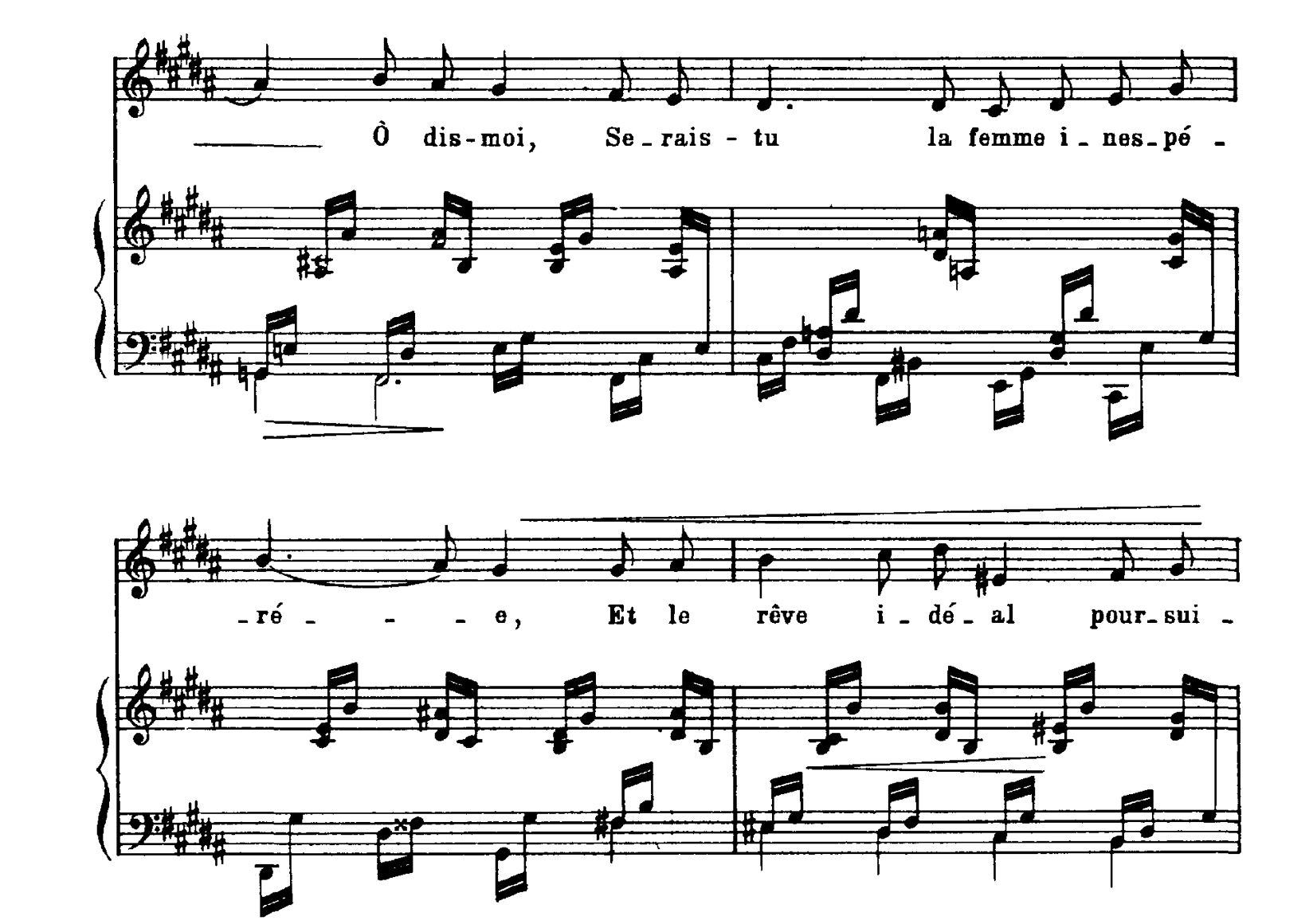
Fauré-Rencontre

We pronounce the text as follows: [o di mwa səˈrɛ ty la fam͜ inespeˈreə]

The word femme is also pronounced with an [a], as you will hear in the following clip at 18 seconds into the recording:

Barbara Hendricks and Michel Dalberto

The Verb Faire:

Commonly mispronounced, the verb faire , meaning “to do” in English, also happens to be one of the most common verbs used in the French language and poetry. There is also a particular pronunciation of the root of the verb in some conjugated forms.

For example, in most tenses of the verb, the -ai- component of the word is pronounced as an open [ɛ] as one would expect. The spelling also totally changes in some of the rarely used tenses, and there is even no root word “fai” anymore. Regarding the -ai- sounding utterly different than what it looks like, here is a list:

PRESENT: je fais [fɛ] tu fais [fɛ] il/elle fait [fɛ]  nous faisons [fœˈzõ]
vous faites [fɛtə]
ils/elles font [fõ]

IMPERFECT: je faisais [ˈzɛ] tu faisais [ˈzɛ] il/elle faisait [ˈzɛ] nous faisions [ˈzjõ] vous faisiez [ˈzje ]
ils/elles faisaient [ˈz ɛ ]

Notice that in the first person plural of the present tense and all of the imperfect conjugation, the verb’s -ai- sounds like [œ].

In the following text from Duparc’s La vie antérieure we find the text: “Le secret douloureux qui me faisait languir” we see two -ai- syllables, and one could assume that they sound the same, but this is the imperfect form of the verb “faire”..

Duparc-La vie antérieure

We pronounce the text as follows: [lə səˈkrɛ duluˈrø ki me fœˈzɛ lɑ̃ˈgir]

You can hear it clearly in the following clip at 3’19”:

José Van Dam and Maciej Pikulski

Eut

Yes, this is a word. In this case, it is a verb. If you have followed any French diction course, you should know that -eu- when it is the last sound in a word sounds as an o-slash [ø] unless the -eu- in question is part of the verb avoir (to have). When it is part of this verb, it sounds very different.

It can be in this form of the verb with an auxiliary:
J’ai eu (I have had) or in this form il eut (he had). It will still sound the same:

J’ai eu (I have had) [ʒe y]
Il eut (he had) [il y]

I have heard this word often turned into an [ø] or even an [œ]. When you translate your text, be sure to be alert and if it is a verb, use the appropriate pronunciation.

In the following clip, you can hear the proper way to sing this sound at 1’58”:

Véronique Gens and Roger Vignoles

A thing that I repeat to my non-native French-speaking students all the time is: “When pronouncing French, please don’t trust your instincts because they are probably incorrect. Stick to the rules and what you don’t know, ask a qualified French diction coach”. There are more words like the ones I have mentioned in this post, but these come back mispronounced, again and again, so memorize them, and you will be ahead of the curve!

Singing in French: Linking Words

“Sing everything like you are singing bel canto” is something I repeat frequently. Bel canto means “beautiful singing,” but it also means to sing everything with smooth phrasing and as legato as possible. Legato is the connected and uninterrupted production of sound, and it requires the singer to understand which vowels and consonants they are singing and how these relate to each other. How do you achieve this if you are not singing in Italian? More specifically, how do you accomplish this while singing in French? Without diving into the numerous French liaison rules, here is a quick explanation of three different ways you can link words in your French singing.

Vowels

The word vowel is taken from the Latin word vox, meaning voice. For singers, a proper understanding of all the vowels in every language t is at the top of the list of essential things to know. The unvoiced consonant stops or blocks the vowel completely, while the voiced consonant partially stops the vowel which causes an audible adjustment to the vocalic flow. Unlike English or German, French seems to run together with no clear separation between words, making French, much like Italian, a very singable language. The legato in the French language is the constant vowel flow within words and between words. This word-to-word flow is achieved by linking words to each other, known as “liaison.”

Here are three methods of linking up words in French:

1. Liaison

Liaison occurs when the usually silent final consonant is pronounced because it is followed by a word starting with a vowel or a mute h. Please note, we never pronounce the “h” sounds in French as we do in English (like in the word “hat.”) For more on the h in French, click here as I have dedicated an entire blog post to this letter, which is not pronounced in French, ironically.

Example:

Elle est arrivée avec un homme (She arrived with a man) [ɛl‿ɛt͜͜͜͜ ariˈve aˈvɛk‿ œ̃n‿ɔmə]

Notice that the t of est and the n of un are in liaison with the following vowels. Usually, these final consonants would be silent (see example below).

Example: Il est venu avec un cadeau (He came with a gift) [il‿ɛ vəˈny avɛk‿œ̃ kaˈdo]

The t of est is now silent as is the of un because consonants instead of vowels follow them.

The singer, working with liaison, should make the now sounded consonant rapidly and quite late because we don’t want to emphasize the liaison. It should also not alter or shorten the vowel preceding it. The use of liaison is more present in lyric diction rather than in spoken French. In everyday speech too much use of liaison makes someone sound quite stiff and old-fashioned. There are quite a few rules related to liaison; some are optional, some are mandatory, and some are forbidden. In some cases, a wrong liaison (for example, making a sound instead of a t) or choosing not to make a mandatory liaison can demonstrate a lack of taste or education.

When using liaison, be aware that some phonetic changes occur with the consonant affected.

  • The s becomes a z: Les amis (the friends) []
  • The d becomes a t: Le grand arbre (the tall tree) []
  • The x becomes a z: Deux amis (two friends) []
  • The f becomes a v: Neuf heures (nine hours) []

Be sure not to get confused with these phonetic changes as they should not change the word’s meaning.

Example :

Sans amour (without love) [sɑ̃z‿aˈmur]

Sens exatasié (senses in extasy)[sɑ̃s‿ɛkstɑˈzje]

As we can see, in the first example, the liaison from the in the word sans meaning without the s is always silent, but in the second example, we always pronounce the s in the word sens meaning senses; we are just linking the words to each other.

2.Elision

Elision is the omission of a final, unstressed -e in a word followed by a word beginning with a vowel or a mute h.

Example; Elle est assise depuis une heure (She has been sitting for an hour) [ɛl‿ɛt‿aˈsizə dəˈpɥiz‿yn‿œrə]

Here we make elision on the final e of elle because the following word, est ,starts with an e, so the l of elle is sounded right before the word est. Elision is commonly used both in lyric diction and in everyday speech.

  1. LINKING UP or “enchaînement”

Linking up or enchaînement occurs when we pronounce the final consonant, whether a vowel follows it or not. It is neither an elision or liaison, and it happens pretty naturally in singing and speaking.

Example il est ici (he is here) [ilɛt‿iˈsi]

The link between il and est is just that, a link. You do not need to show the link in your IPA translation only from a liaison or an elision.

Optional Liaisons

As you get more familiar with liaison, you will have the knowledge needed to opt-out of some liaisons that seem excessive. To quote Pierre Bernac (see below), who was an authority on “French Mélodie”: “There are a great number of cases when the liaison is optional, and left to the taste of the performer.” However, for a singer to know when they can leave out a liaison, they must have a thorough knowledge of singing in French.

Consulting a French Lyric Diction coach or an excellent French diction manual will be the best course of action rather than asking a friend who speaks French. Everyday French does not necessarily require the knowledge of the relatively large set of rules used for singing in French. There are many things to consider when singing in French, so always make sure you cover all your bases.

Did you know:

An excellent book to start building your library is The Interpretation of French Song by Pierre Bernac. He explores the musical analysis and suggested liaisons in the texts to help you find your way with French Mélodie.

Pierre Bernac (12 January 1899 – 17 October 1979) was a French singer, a baryton-martin, known as an interpreter of the French mélodie. He had a close artistic association with Francis Poulenc, with whom he performed in France and abroad. Poulenc wrote 90 songs for him during their 25-year musical partnership.

Bernac was well known as a teacher; among the singers who studied with him were Elly AmelingGrace BumbryMattiwilda DobbsCarol NeblettJessye Norman, and Gérard Souzay. He gave masterclasses in France, Britain and the US.

 Bernac wrote two highly regarded books about the interpretation of mélodies in general and Poulenc’s in particular.

Pierre Bernac – Wikipedia. https://en.wikipedia.org/wiki/Pierre_Bernac

Vocalic Harmonization in French Singing

What is Vocalic Harmonization?

Maybe you have heard this term before, or perhaps it is new to you. When I coach people for the first time, it always seems like they are familiar with Vocalic Harmonization, but they are not sure how to use it. It is a term used in linguistics when applying the rhyming of closely related vowels in the same or words that follow each other. It is also known as “vowel harmony”. The practice of vocalic harmonization is most often used in the French vocal repertoire for linguistic refinement and ease of vocal production. Most frequently in French singing, we harmonize [ɛ] with [e] and [œ] with [ø]

For example:  “aimer” [ɛˈme] becomes [eˈme] or Heureux [œˈrø] becomes [øˈrø]

As you can see in the examples above, the unstressed, open vowel-sound closes to rhyme with the following stressed, closed vowel, not the opposite. Remember, it is the final syllable that is stressed in French, except when that syllable is a schwa-sound [ə] because a schwa can never be stressed. In this case it is the syllable before the schwa that gets the stress.

les, tes, ses, mes, ces…

the possibility of vocalic harmonization also exists in closing the [ɛ] in short words such as les, tes, ces, etc. (these are articles or possessive adjectives). When a closed vowel immediately follows these, they can be closed to an [e].

For example: les étés [lɛz‿eˈte] would become [lez‿eˈte]

The article “les” is harmonized to the closed [e] in “étés”

These harmonized syllables must never be accented or overly closed, and at times they only are slightly closed on the way to their closed neighboring vowel-sound, and over-closing the harmonized vowel can result in obscuring the text. The idea is that it should feel natural and sound authentic since vocalic harmonization occurs in everyday speech but not deliberately. Many native French speakers do not even realize that they are doing this.

Some French words are almost always harmonized. For example, the following words would have all open vowels in the first syllable if we followed the diction rules, but they are sung and spoken with vocalic harmonization:


aimer (to love) [ɛˈme] becomes [eˈme]
baiser (to kiss) [bɛˈze] becomes [beˈze]
heureux (or heureuse) (happy) [œˈrø] becomes [øˈrø]


Vowel harmonization should not be systematic. It is a completely optional choice left to the singer. In cases where it can help the legato line, it is recommended to harmonize the vowels as sometimes it is easier to get through a phrase with fewer vowel changes.

For example:

Let’s take a look at “Lydia” by Fauré. In this text we find this line: “Laisse tes baisers de colombe”

The “tes baisers” can be sung as all closed [e] but the “laisse”” remains an open [ɛ] because the vowel following it is not a closed vowel.

[lɛsə tɛ bɛˈze] becomes [lɛsə te bɛeze]

Speak it out loud both ways and see the difference for yourself.

I would also go further and say if you have an article or possessive adjective (les, des, mes, tes ses) and the following word begins with a closed [o] or any vowel that has a closed feeling such as [i], [ø] [õ] [y] or [o], you can apply vocalic harmonization.

Again in in “Lydia by Fauré:

“Lydia, sur tes roses joues” you can harmonize the “tes” which would typically be [tɛ] to a closed [te] to match the closed [o] sounds of [rozə]. But, the “mes” in “mes amours” in the same song stays [ɛ] because a closed vowel-sound does not follow it.

Here is the text of Fauré’s Lydia where I will highlight the vocalic harmonizations:

Lydia, sur tes roses joues
Et sur ton col frais et si blanc
Roule étincelant
L’or fluide que tu dénoues;
Le jour qui lui est le meilleur
Oublions l’éternelle tombe
Laisse tes baisers de colombe
Chanter sur ta lèvre en fleur.
Un lys caché répand sans cesse
Une odeur divine en ton sein;
Les délices comme un essaim
Sortent de toi, jeune déesse
Je t’aime et meurs, ô mes amours,
Mon âme en baisers m’est ravie
O Lydia, rends-moi la vie,
Que je puisse mourir toujours!

In this recording of Véronique Gens and Roger Vignoles, you can hear the use of vocalic harmonization as highlightede above.

Véronique Gens and Roger Vignoles

Try not to over-use vocalic harmonization. Remember, it should not obscure the text, and it should be helpful to the singing. If you are not sure if something should be harmonized or not, ask your French diction coach, or listen to several recordings to see what the consensus is. Just know that some coaches don’t apply vowel harmony and there are differing opinions on the matter. Since it happens in everyday speech, and I have seen it help so many singers in their legato and ease of singing, I generally encourage vocalic harmonization when appropriate.

Thoughts on the French “R” in Classical Singing

The French r may be one of the most discussed sounds in the French language. It is also one of the most challenging sounds for a non-native French speaker to produce authentically. There are many ways to go about singing the French r.

Let’s look at the three most commonly used r-sounds in singing French repertoire:

  • The “rolled r“: The “rolled r” is also known by its more technical name “alveolar trill”. This is the r we are most familiar with, we use it in all other languages. It is voiced which means you should be able to sustain a sound while rolling the r. The phonetic symbol for this sound is [r]
  • The “flipped r: The “flipped r” is also known as an “alveolar tap or flap”. Very similar to the “rolled r” the flip requires just one brief flick of the tongue to the alveolar ridge. Think of saying the letter d [d]. The phonetic symbols for this vowel sound are [ɾ] or [r], but the latter is the most commonly used.
  • The “uvular r”: Also known as the “uvular trill” is the r commonly used in the French spoken language, but also singing. The uvular r is articulated with the back of the tongue (what is known technically as the dorsum) to the uvula (the hangy thing in the back). The difference between the rolled/flipped r and the uvular r is that it is the uvula that vibrates, not the tongue. The phonetic symbol for this sound is [ʀ].

So now that we have listed the three most commonly used r-sounds in French singing, which ones should be used?

Although the “rolled r has quite frequently been used in the singing of classical French repertoire, and it feels good to do it (sometimes it may feel expressive to roll an r), my advice is to avoid using it. Whenever I hear someone over-rolling an r in French music be it mélodie or opera, it ends up sounding very close to Italian. Also, any double consonant (except for a few words) should not be observed, so even if you see a double r, you do not need to roll it.

In the following clip, Chanson d’Orkenise from Banalités by Poulenc, Pierre Bernac, who was and still is an authority on singing in French, makes use of the “rolled r” (or one could argue that it is a repeated flipped r). It is still beautiful, but it has a flavor of the past mostly due to the r which is very rolled. This is a good example of how they were singing in French in this period.

Chanson d’Orkenise (Bernac/Poulenc)

The “flipped ris my personal favorite to use in classical French music. This r is a lot like its rolled counterpart. If you use it while speaking, it feels very strange and foreign but it sounds very comfortable while singing. It does not misplace the voice and it does not disturb the legato line. It is the r most commonly used in French opera and mélodie. In this recording , you hear an excellent use of the “flipped r” used by Véronique Gens.

Chanson d’Orkenise Gens/Vignoles

There are a lot of discussions about the use of the “uvular r in classical singing. While speaking French, we all use this r but should we use it when we are singing classical music? In France, Belgium and I believe in the French-speaking regions of Canada, the “uvular r” is recommended for singing in French. From a singing perspective, the argument arises that this places the sound too far back in the throat and that a “flipped r” keeps the sound more forward. In my opinion, the use of the “uvular r” gives a “pop music” feeling to the music. The discussions surrounding which r we should be using are ongoing. My advice is if you are not a native French speaker, do not use the “uvular r” because the chances are you will not make a convincingly authentic “uvular r” sound while singing.

Story time...

I once had a student who was not French, bring in a French aria he had studied all week. Before singing it, he said: “I don’t know why, but every time I sing this aria, I have a sore throat”. Alarmed, I wanted to hear it to see if he was doing anything wrong. It should be noted that this aria was very r heavy. Well, as soon as he started singing, I heard it immediately, he was using his version of the “uvular r”, but it was much too hard and aggressive, we switched to the “flipped r” and everything was solved. We had a good laugh about it afterward!

In this third recording of Chanson d’Orkenise by Poulenc, Patricia Petitbon opts for the “uvular r“. She does it with subtelty and she is gentle with the attack but you can hear that it is in the back of the throat.

Chanson d’Orkenise Petitbon/Manoff

My strong advice (and many of my voice teacher colleagues agree) is to use the “flipped r”. Whatever you decide to use, make sure it does not compromise the quality of your singing. Practice now and then with a “uvular r” in case you go off and work with someone who will have this as a preference, and it is requested of you to use it. Work it out with your French coach and your voice teacher to help you to do it healthily and authentically.